
VILLAINOUS REWARDS

Hello, Ladies ~

Have any of you cried when you had to kill your villain? I’m not sure why, but it upset me greatly when my villain in “Chaos in Cabo” sailed off a cliff in a hail of bullets. I sobbed as I finished Alida’s story, trying to find comfort in the fact that she sacrifices herself to save Antonio, the man she loves.

Or maybe I listened to a recent reader who said, “I love that your villains find redemption, but don’t you think they should also pay for their crimes?”

Years ago, when I submitted my very first manuscript, “Murder in Margaritaville,” to agents and editors, I received the standard “No Thank You” form letter. But each letter had an interesting addition: You do write a very good villain.

Encouraged by the repeated comment, I studied how I had written my villain. Of course, as with all my characters, my villains are created with traits from people I’ve met throughout my life. From men who treated me badly to women who betrayed our friendship, I have a plethora of evil qualities to attribute to my villains.

I also learned from studying how I wrote my very first villain, Damian Garza, that his character had more depth than my heroine, Clara. Another tidbit was that I wrote Damian in third person instead of Clara’s narrative in first person. However, the biggest revelation was discovering that writing in the voices of my three main characters — the heroine, the hero, and the villain — allowed me to create more three-dimensional characters.

“Murder in Margaritaville” would never obtain an agent or publishing deal. Luckily for me, though, my fabulous friend, Paty Jager, helped me begin my self-publishing journey, and this novel became “Malice in Mazatlán.”

The words, “You do write a very good villain,” have stuck with me throughout my writing career and helped to hone my process. I always start with a title because, for me, the title guides the story. The next book in my Mexico Mayhem Series is “Lost in Loreto.” It took me a few months to decide who was lost and what had caused them to be missing. The cause, of course, originates from my villain’s actions. When the opening line appears in my writer’s brain, I get giddy with excitement to know how the story begins.

Now that I know my villain’s crime, I spend time with him or her asking those pertinent questions: Why? How? When? What? Where? At the beginning of my villain, Arlo’s story, he has no redeeming qualities at this point. But I know from experience that it can change as the other characters begin their search for the missing Gabriella.

In this series, my hero, Javier, is a character who has moved forward from “Chaos in Cabo,” but I needed to introduce a new heroine. In “Lost in Loreto,” this character was a bit of a challenge. When Scarlett Quinn finally materialized, I was thrilled with the direction the story would now take. Oh, what “fun” she’s going to cause.

I usually know the general storyline of the novel I’m writing, although I’ve had characters change the trajectory of their story, which changes everything. In “Lost in Loreto,” I knew as soon as I researched the location of the crime, fleshed out my victim, and wrote the first chapter … what awaits my villain, Arlo. And if my characters stick to their roles, I doubt any tears will be shed when Arlo receives his “punishment.”

Even though I’m back to working on my next WIP, tears still fill my eyes when I think about Alida. I know she needed to pay for her crimes in some fashion, but until I wrote her last two chapters, I didn’t know she would be the one to end her story.

I’ve written six novels and three novellas now, and I’m so thankful for the creative license that self-publishing allows me. Without anyone demanding a finished product by a certain date (except me, of course), I can work on three different books at the same time if I want to.

But I’m also thankful for the time those agents and editors took to tell me: You do write a very good villain.

Happy writing, Ladies, and may all your villains be deliciously villainous!
HIDDEN GEMS

Hello, Ladies ~

When I was a kid, I loved playing the game of “Clue.” Piecing together the clues to decide if Miss Scarlett killed the victim with a candlestick in the conservatory was exhilarating.

And was there anything better than watching “Perry Mason,” “Matlock,” or “CSI?” I would settle in to watch these shows armed with a pen and pad, making notes of possible clues to help me solve the crime before the episode ended.

A few weeks ago, a writer friend and I were talking about writer’s block, something she’d been struggling with. When I said I never suffer from writer’s block, she raised an eyebrow.

I continued, sharing that my brain sort of takes over and directs my fingers across the keyboard, or guides the pen in my hand across a blank page.

“Can you give me an example?” she asked.

My response, then became my blog for this month …

While I don’t write mysteries per se, I do like to add a touch of mystery to my books. In my first novel, “Peril in Paradise,” I discovered that my writer’s brain had automatically planted clues about my crime and villain. In my series México Mayhem, the reader knows who the villain is from the beginning, but I still create a sense of mystery by adding perfect hidden gems to keep the reader guessing.

Two of my favorite additions were characters who weren’t meant to be in more than a couple of scenes. In “Peril in Paradise,” I created Billy Boyd, who becomes my villain Damian’s cellmate. I didn’t know when I created Billy, initially intending for him to add color to a few scenes with Damian, that he would become his own interesting character.

In “Malice in Mazatlan,” Alba’s only purpose was to paint a picture for the reader of how difficult my villain, Sarita Garcia, could be. But Alba ends up stealing a scene and becoming a perfect hidden gem.

As I reread the current WIP for my México Mayhem Series, “Vanished in Vallarta,” I realized I had added some hidden gems during the first draft that I could now use as clues for the Hero and Heroine as they try to tie a suspect to a murder. When I edited the Villain’s chapters, I discovered I’d done the same thing with her storyline.

Every time I find these intriguing nuggets, I’m in awe of how my brain has placed a little of this and a little of that in the right places of the storyline, which I can now turn into tantalizing tidbits for my readers. Another fabulous thing occurred, too. Without knowingly inserting this information, I created a storyline for my next book, “Lost in Loreto.”

In the first novel, “Redneck Ranch,” of my Stoneybrook Mysteries, I added stab wounds to my victim and placed her on the dirt floor of an old barn. But I didn’t know at the time the stab wounds would reveal Morse Code for a number or that the barn floor being void of blood would suggest a different crime scene for this victim.

I just finished a short story, “Jamboree Jealousy,” for an anthology, and when I did my read-through, I smiled at the hidden gems I’d already added to the story: A missing cowboy hat. A gold hoop earring. A few pages with lyrics for a song.

I hope there are many Hidden Gems in your writing endeavors, too! Happy Writing, Sisters!

CHALLENGING SISTER

Happy Summer, Ladies ~ I wanted to start by thanking all of you who reached out during my sister Lori’s illness, and to let you know she passed away on June 2nd.

My sister, fourteen months younger than me, always challenged me to be a good big sister.

Lori loved tossing her baby bottle from her crib and squealing until someone would retrieve it. Our single mom, Rita, would be busy cooking, cleaning, or getting ready for one of her three jobs, so I would toddle over and hand my baby sister her bottle. Lori would enjoy it until she wanted attention again and then toss it overboard again.

Lori challenged me to be my sister’s keeper when we were little girls. My job was to hold her hand, ensuring she stayed out of trouble when Mom took us shopping or to visit our grandparents’ small mom-and-pop store. On one exciting trip to Sears to shop for new summer sandals, I let go of Lori’s hand, and she wandered off.

“Where’s your sister?” Mom asked, frantically looking around the store. I shrugged and looked around, too.

My mother shrieked and raced toward a display of bathroom toilets, where my little sister sat perched on an avocado green throne.

“I go big girl potty, Mommy.” Lori beamed despite Mom snatching her from the toilet. She pulled up my sister’s panties and smoothed her sundress. Before leading her away from the display, my mother made the mistake of looking in the bowl where Lori had left a tiny brown deposit.

Needless to say, we didn’t go back to Sears for a few years.

As teenagers, Lori challenged me to be a less stuffy older sister. I was prone to wearing turtlenecks and loose-fitting Levi’s, while Lori preferred a hipper wardrobe of scoop-neck T-shirts and tight bellbottoms. One day, she and I went to the Medford Center to do a little shopping. Even though enough time had passed and we could have shopped at Sears, we decided on JC Penny’s. Lori stuck me in a dressing room and brought me clothes to try on.

I wore one of my new outfits to school the next day: a yellow blouse with cap sleeves and dark blue denim bellbottoms. I finally got my first compliment from a boy I liked when he said, “Nice jeans.”

As adults, Lori became an unwavering source of support when my son, Derrick, was diagnosed with autism, and I found myself a divorced mother of two. She watched my boys. She encouraged me to date. She taught me how to dance.

Despite her helpfulness, my relationship with my sister was also difficult. Sometimes I wanted to walk away from her instead of trying to mend whatever bridge she’d burned. So, as I said at the beginning, my sister Lori was challenging, and I share this story because I believe our relationship taught me how to shape characters for my books.

Whether I’m writing a Hero, a Heroine, or a Villain, I know I infuse my characters with some of Lori’s personality traits.

Clara in “Peril in Paradise” has Lori’s indomitable determination to find revenge for her daughter. In “Redneck Ranch,” Harley and Busy’s best friend relationship is a take-off of mine and Lori’s sisterhood. In “Vanished in Vallarta,” Jade is on a mission to find her missing little sister.

My female or male villains reflect some of her flaws, too, such as her unreasonable jealousy or sense of entitlement. Though Lori wasn’t necessarily evil, she did have a mean streak that, at times, she directed at me.

Over the last seven months, Lori challenged me to be a better writer. A better storyteller. A better editor.

She wanted to help me edit my current novel, “Chaos in Cabo.” I set her up with chapters, blue and red pens, and the nine things I look for in each chapter. The senses: Sight, Smell, Sound, Taste, Touch. And the nuances, I think, bring realism to my story: Accessories, Clothing, Eyes, Hair.

Lori valiantly tried to read each chapter and mark these items off the list, but she had a hard time focusing on the story. However, she did ask good questions, so the end result for me was that I was able to explain my editing process to another writer who asked if I would edit her novel.

My sister Lori was a challenge to the end. She died on June 2nd, my son Derrick’s birthday.

We had a lovely family day on June 1st, her son’s birthday. We played games, ate pizza, and enjoyed an ice cream cake. I spent the night at her house, and we stayed up late talking and laughing.

The next morning, Lori seemed a little tired but otherwise fine. She commented about not being able to get into heaven if you weren’t always a good person. I told her that if she wanted forgiveness, all she had to do was ask God. She got quiet for a few minutes and closed her eyes. Then she said, “I feel bad that I get to see Derrick before you.”

My phone pinged because someone liked my Facebook birthday post for Derrick, and I showed Lori his picture.

She grabbed my hand, and my sister, who never asked me to pray with her before, said, “Can we say a prayer for Derrick’s birthday?”

I nodded and said, “Happy Birthday, Derrick. We hope you’re having a great day in heaven. Aunt Lori and I are laughing about Grandma Rita and Grandma Betty arguing over who gets to bake you a cake. I love and miss you, big guy! Aunt Lori wants to say something.”

Eyes closed, she squeezed my hand and said, “Happy birthday, Derrick. I miss you so much. And I want you to know I’m coming to see you soon.”

Lori drifted off to sleep and seemed fine throughout the morning. Then, just after noon, her breathing became labored, and she appeared to be in a coma. Her husband called the Hospice nurse, who was running late, and she said she would be there as soon as possible.

Keith and I took turns holding Lori’s hand and making her comfortable. Neither of us was in denial that her time was near, but neither of us was ready for her to go.

My challenging little sister went to heaven at 1:50 pm on Monday, June 2, 2025.

Several people said to me after Lori passed away that they were sorry she died on Derrick’s birthday, to which I replied:

“I’m not because I believe my loving son reached his strong hand down from the heavens and said, ‘Come on, Aunt Lori … it’s time.’”

Over the rainbow and from heaven, my little sister challenged me to lean into my faith and share her peaceful passing with others.

Hug your family members, Sisters!

WEEPING WILLOW

Hello, Ladies ~ Sorry this post is late. I’ve been at our cabin for the long weekend, which doesn’t have internet. I tried to upload my blog a couple of times while in Lincoln City, but the internet at most places is spotty at best.

When my husband, Randy, and I bought our house in Donald, I was thrilled we had a willow tree in our backyard. The lovely eight-year-old tree helped to block the city’s big blue water tower.

Since our lot sat at an angle and backed up to a farmer’s field, we couldn’t see our neighbors on either side of us. I loved the illusion that we lived in the country surrounded by beautiful crops.

Of course, as time ticked by, my beloved willow tree grew taller and broader as we grew grayer and rounder, the unstoppable march of time making all of us older.

Every fall, Randy and I would struggle to keep up with the never-ending shower of colorful leaves blanketing our patio, creating a slick carpet of decaying debris. Spring would bring the dropping of the budding leaves’ cuticles, which looked like a sea of bumble bees inhabiting the patio.

Our now-massive willow tree also had branches that extended over flower beds, causing plants to die or grow in weird directions to capture some sunlight. Randy’s biggest fear was that the now forty-foot tall and thirty-five-foot-wide tree would fail, and the branch looming over our roof would do some serious damage.

We finally had to make the gut-wrenching decision to cut down our majestic Weeping Willow. I cried as the arborist and his crew dismantled the tree in sections. But the hardest part for me was when he shot poison into the lonely stump. He’d just killed something I’d enjoyed for years.

During this time, I was working on the first draft of my novel, “Chaos in Cabo.” I’m close to typing The End and working on tying up all my story threads. I’ve been struggling with how to end my villain’s story. As the arborist and his crew cut down my willow, it occurred to me that I grew attached to things … including my characters.

Even though I know she needs to be punished for her crimes, the idea of sending her to prison pains me. My alternative idea, having the man she loves kill her, seems so harsh.

Why is it so hard for me to let go? I mean, my villain is a fictional character. It’s not like I meet her for Happy Hour every month. And I usually fashion my villains after people I’ve met who wronged me somehow. This female villain was named after a woman who stole the guy I was dating after pretending to be my friend. So essentially, I’d be virtually settling a score with her. Right?

In my past novels, I’ve redeemed a few villains, punished a few, and, of course, a few have died. In “Malice in Mazatlan,” I faced the same dilemma as I’m experiencing with “Chaos in Cabo.” I loved my villain, Sarita Garcia, so much that I decided I couldn’t end her story, and she appeared in “Vanished in Vallarta.”

As Randy and I approach retirement, I’ve been faced with “letting go” of things. Downsizing is painful, but I find joy in donating items or handing off family treasures to the younger generation.

I recently gave pieces of décor to a niece. She was so thrilled she sent me a thank you note with pictures of the repurposed decorations in her small house. It made me think about what my readers might expect as they read one of my novels. Maybe they’ve decided in their minds as they read “Chaos in Cabo” that this villain seriously deserves her just desserts and isn’t worthy of being “repurposed” or “redeemed.”

One of my readers said they loved that I infuse my villains with qualities that make them human to balance their evilness. She said, “I find myself rooting for your villains despite their crimes.”

But can I justify allowing the villain in “Chaos in Cabo” to live since she threatens the lives of people from her lover’s past? He would be devastated if she killed his loved ones and would never be able to forgive her, which would create a prison of a different kind.

While I’m sad at the loss of my beautiful tree, the plants in the flower garden that once were shrouded in shade are thriving. I like the idea that letting go of something opens up possibilities for brighter occurrences… and, hopefully, rewarding stories for your readers.

Happy Memorial Day, Ladies! I hope you had a fabulous day with family, friends and … your characters!

GREETINGS FROM CABO

¡Buenos días desde Cabo San Lucas!

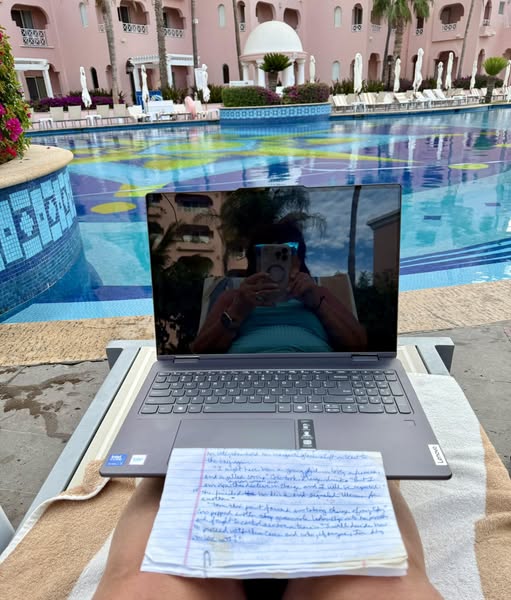
How blessed am I to be able to write this blog while poolside at the Pueblo Bonito Rose Resort? I meant to post this last night, but at eleven-ish, I noticed I hadn’t quite finished my train of thought and decided this morning would be a better time to edit before too many cocktails.

Randy and I have had a relaxing vacation so far. Though I’ll be sad to fly back to Oregon on Saturday, I’m thrilled that I’ve been able to write and hopefully finish “Chaos in Cabo” while in Cabo!

I’d hoped to have this book done before now, but that thing called life threw me more curve balls than a major league baseball game over the last six months, so I’ve worked on the manuscript here and there.

But once we were at our resort, drink in hand, sunshine turning my skin a lovely reddish pink; I felt the creative juices flowing. The first thing I did was reacquaint myself with the story and characters. And oh, how I’d missed them. I hadn’t realized I’d left Coco and Amado in a fight over whether they loved each other enough to sacrifice their separate lives to be together. And how could I set up my villainess to have a major secret revealed and then not write the scene?

Those weren’t the only threads that needed attention. When I walked along the beach basking in the waves from Medano Bay, it occurred to me that in my book, I call the bay the Sea of Cortés. And worse yet, I’d written that Amado and Coco used to surf off of “Lover’s Beach.” An impossibility since the beach sits within the bay.

Like I said, I am so blessed to be able to be here where the story occurs and realize my mistakes!

After a few days of editing and rewriting, I could continue with the novel. And I wasn’t the only one ready! These characters don’t care that I’m on vacation and should be sleeping late before relaxing by the pool. They’ve been waking me up at five-thirty, demanding I set my fingers to the keys of my laptop or pen to paper as I stand in the pool … and get busy.

As you may remember, I write my novels from the POV of the three main characters, rotating chapters with their POV. I love this style because it always allows me to flesh out my characters more and contemplate what happens to them next and how their story moves the whole story forward.

But that hasn’t been enough for these characters. Coco decided before it was her turn to regain control of her life and put the two men vying for her heart in their places. Amado believes he’s lost his quest to sail off into the sunset with Coco and live happily ever after, and he makes a huge mistake. Alida feels she’s made an error in judgment by falling in love with the office manager for her scam-calling crew and fears he may be her undoing.

I’ve mentioned before that sometimes my secondary characters decide they need a better story, too, and do things I hadn’t originally planned. That’s the case with Antonio, Alida’s soft-spoken office manager. Oh, the story he tells about his previous life … even I was enthralled. And when did Nacho decide to disappear with his wife and son?

I swear this novel seems to be writing itself. Is it because I’m here in my México, in the land of sun, sea, and margaritas? Is my creativeness heightened because I can see my characters living in this tropical paradise? Should I get a job as a waitress, learn to speak better Spanish, and stay until all the novels in my Mexico Mayhem series are written?

I doubt my husband would support me staying, so I hope my characters pack up and come home with me when I pack my bags to return to Oregon. I believe I will retain some of the beauty and wonder of Cabo once I’m home, but writing “Chaos in Cabo” while in Cabo has been one of the highlights of my writing career.

So, for now, I bid you adiós as I go in search of my first mimosa of the day. ¡Salud!

Feliz escritura, señoras ~