Tidings of Comfort and Joy: Old Books

I have a lot of books. I love to read. I suppose that’s why I became a writer. I want to tell the stories as well as read them.

No, I haven’t read all the books on my shelves. I enjoy the anticipation and the possibilities of reading them, someday.

Yes, I’ve read many of my books. There are old favorites I read over and over. With the advent of the internet, I discovered I can buy books that I read long ago, for the pleasure of having those books on my shelves, whether originally written for children or adults.

The recent airing of Ken Burns’s The American Revolution has me thinking of that era. However, the American Revolution novel on my shelves takes place in England. The Reb and the Redcoats, written by Constance Savery, was published in 1961. Charlotte Darrington, her brothers Joseph and George, and her little sister Kitty live in a manor house with their mother and their grandparents. Their father, a British officer, is fighting in the colonies. Uncle Laurence, also an officer, has recently returned from the war. The Reb—Randal Everard Baltimore—is a prisoner of war billeted with the family, a 15-year-old boy who was captured aboard a ship while carrying war dispatches from America to France. He’s escaped several times and is now kept under lock and key. A friendship grows between the Reb and Charlotte. It’s a fascinating book, letting the reader glimpse the Revolution from the point of view of English loyalists. I highly recommend it.

A longtime favorite by Phyllis Whitney also sits on my shelves, a book that early on fed my fascination with Japan. Whitney was born in Japan and spent her early years in Asia. The book I love is Secret of the Samurai Sword, published in 1958. Celia and Stephen Bronson arrive in Kyoto to spend the summer with their grandmother, a writer. They soon learn that the ghost of an old-time samurai supposedly haunts the garden. The artist who lives across the street, Gentaro Sato, is sure that it’s the spirit of one of his ancestors. Sato doesn’t like Americans. He’s determined that his Nisei granddaughter, Sumiko, who has come from America with her mother to stay with him, will conform to Japanese tradition, whether she likes it or not. Stephen and Sumiko’s cousin Hiro camp out in the garden, determined to see the ghost, but the figure disappears. It’s left to Celia to find out the truth.

Anya Seton wrote two books that sit on my shelves, read and reread. One I discovered because it was in a Readers Digest Condensed Book. It’s Devilwater, which is a fascinating look at the Jacobite Rebellions of 1715 and 1745, and the American frontier in the intervening period, when one of the characters travels to Williamsburg and points beyond. The other Seton book that I frequently revisit is Avalon, set against the background of Anglo-Saxon England, with Vikings expanding their influence to Iceland and Greenland. Both the Seton books are grand historical novels, the kind of books I love, rich with characters, story and details.

I’ll finish this short list of books that bring me comfort and joy with one that I’ve read so many times I swear I have it memorized. My mother had a copy on her shelves, and I first read it way back in my junior high school years. I was dismayed when she loaned it to someone who never returned it—an unpardonable sin, in my opinion.

The book is Désirée, by Annemarie Selinko. Published in 1951, the book takes the form of a diary written by Désirée Clary, the daughter of a silk merchant from Marseille. The book begins in 1794, some five years after the start of the French Revolution, and the naïve 14-year-old has just met an upstart named Napoleon who professes to love her, though he throws her over for a more advantageous marriage with Josephine. Through the course of this historical novel, we get a fascinating picture of France during and after the Revolution, with Napoleon’s reign and his wars thrown in for good measure. And through the years, Désirée observes it all and finds a man who truly loves her.

Ah, books, so many books, so many possibilities—and so many pleasures!

The Cookies of Life

Years ago, someone gave me a small pillow with the following quote:

Lately, the cookies of life have been handing me some broken pieces. Now, more than ever, I am grateful and thankful for my friends. They are abundant and stalwart chocolate chips.

Friends come in all varieties and are acquired in many ways. There are old friends, people I’m close to that I’ve known for a long, long time. I often call them friends of longstanding. Right now I’m thinking of three very close and longstanding friends. One I’ve known since high school, a friendship lasting nearly 60 years. Another friendship is coming up on a 50-year anniversary, someone I met while we were both serving in the Navy. A third friend I met through our mutual interest in mystery fiction and we’ve known each other 45 years.

There are friends who are also relatives, cousins that I’m close to, who I can share things with. There are other friends I’ve known since junior high and high school, bonded by that shared experience a long time ago. Friends met while I was serving in the Navy, people I’ve kept up with all these years.

Friends from the mystery writing and fan community, sharing a love of books, particularly those that feature fictional dead bodies. The kinds of friends I can talk shop with, discussing our works in progress as well as the vicissitudes of life.

Friends I met in the workplace, from jobs I’ve had over the years. We’ve stayed in touch, even though we are no longer coworkers. I lost one such friend earlier this year. She lived in San Francisco and was my buddy for outings to museums, the theatre, the symphony. I’m still getting used to going to plays by myself instead of calling her up to see when she has availability on her calendar.

I have friends I’ve known for years because I’m part of a loosely-knit cat sitting group—we take care of each other’s cats when we’re out of town. The cat ladies, as I call them, are the ones who looked after my fur babies for weeks during my mother’s last illness and the aftermath—and left food in my refrigerator when I returned home following the funeral.

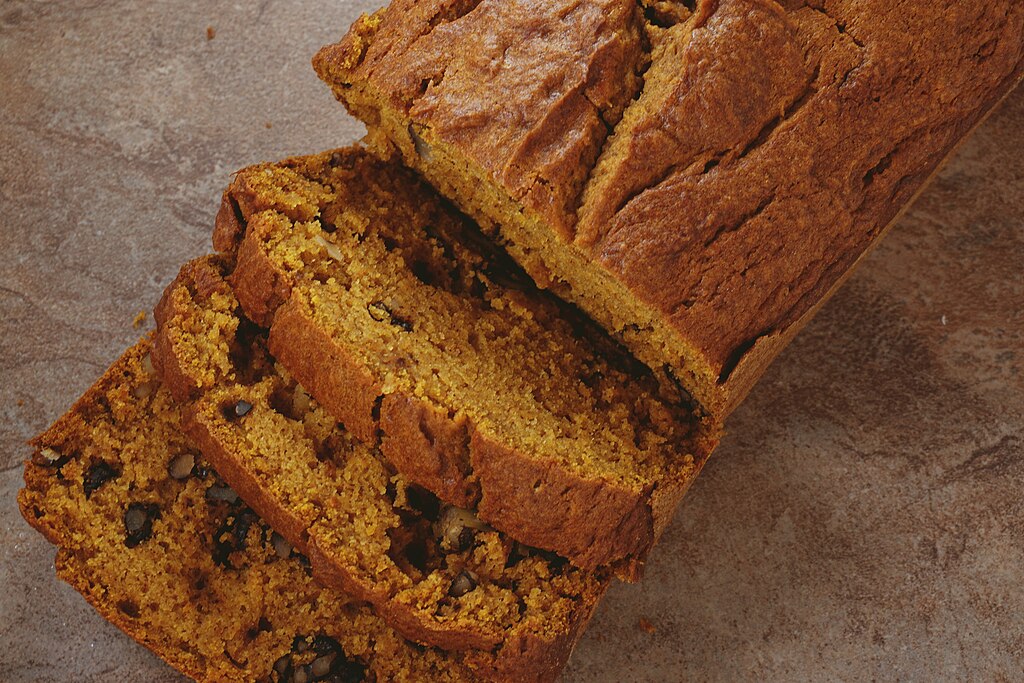
I also have friends in my tai chi group. They are great fans of my famous carrot cake when I bring it to potlucks. They have been sending me good chi during my recent illness. And new friends acquired in my Italian class at the local senior center who took the time to sign and send a get-well card.

I have friends where I live. I bought my condo 33 years ago and I am blessed with good neighbors. There’s a neighbor a few doors down who takes in my mail and waters my garden when I’m out of town. She drives me to the airport and train station, and I do the same for her. There’s another neighbor across the way who shows up with his toolbox to give me a hand when I need it. Another neighbor does cat care visits in a pinch. And recently several neighbors have bought groceries for me and driven me to medical appointments.

So here’s to you, my friends. And many thanks. You’ve added sweetness and flavor to my life.

Artful Travels

Here’s a quote from Ian Fleming, World War II Naval intelligence officer—and author of the James Bond novels:

Never say ‘no’ to adventures — always say ‘yes.’ Otherwise, you’ll lead a very dull life.

Dull life? Not me.

Recently my life has been anything but dull. Though not the way I planned it.

When I wrote the first draft of this blog, I anticipated it would appear days after my return from two glorious weeks in Bella Italia.

Naples, Pompeii, Herculaneum. Rome, the Eternal City. The Vatican museums. The Coliseum. Florence, steeped in art, the statue of David looming over all of it. Venice with its canals and gondolas.

It didn’t happen. I had to cancel the journey I’d been planning for over a year.

A week before I was due to leave, I started getting low heart rate alerts on my Fitbit. Off to the emergency room, where an afternoon of EKGs, bloodwork and doctor consultations revealed that I needed a pacemaker. The doctors didn’t advise traveling for four to six weeks. Surgery, then home, then back to the ER with a fluctuating heart rate—again. One of the leads on the pacemaker had come loose. Another surgery, this time to replace that lead and reposition the others. I came home from this second hospital stay the day I was supposed to leave for Italy.

The travel insurance claim is in the works, and I’ve rebooked the trip for next spring. I’ll get to Italy yet.

So, why Italy? It’s the same reason that led me to Greece two years ago, and an upcoming trip to Egypt in January. History and art. I have an MA in history and all those books on my shelves. I love going to museums and wandering through galleries full of wonderful art. My favorites, the Impressionists. When I was in Paris decades ago, I went to the Louvre three times and the Orsay Museum twice. I sought Monet at the Orangerie, the Marmetton and took a trip to Giverny, where he painted and where I discovered he loved Japanese woodblocks as much as I do.

I used to say I didn’t like modern art. Then some years ago, the San Francisco Museum of Modern Art mounted an exhibit featuring Richard Diebenkorn. I went twice. Time to take a different look at modern art and understand it a bit more.

I took an art history course. I’d always thought about doing that when I was in college and never got around to it. I enrolled at the local community college and went to classes, accompanied by the weighty tome I bought in the college bookstore. I was the oldest person in the room, including the instructor. I learned a lot.

The class broadened my appreciation of art and reignited my desire to travel. Not to the land of the Impressionists, but to the ancient world. Hence the trip to Greece. I climbed to the top of the Acropolis and marveled at the treasures in the Archeological Museums of Athens and Crete. I saw the statue of the Charioteer in Delphi. On Santorini, I went to the ruins of Akrotiri, a town destroyed by a volcanic eruption in the 16th century BCE.

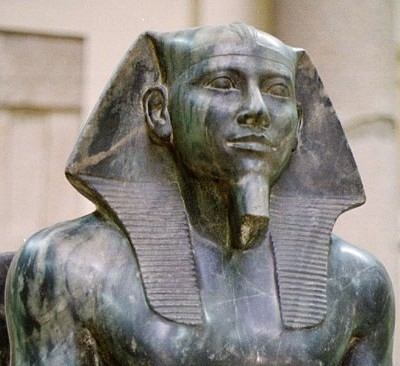
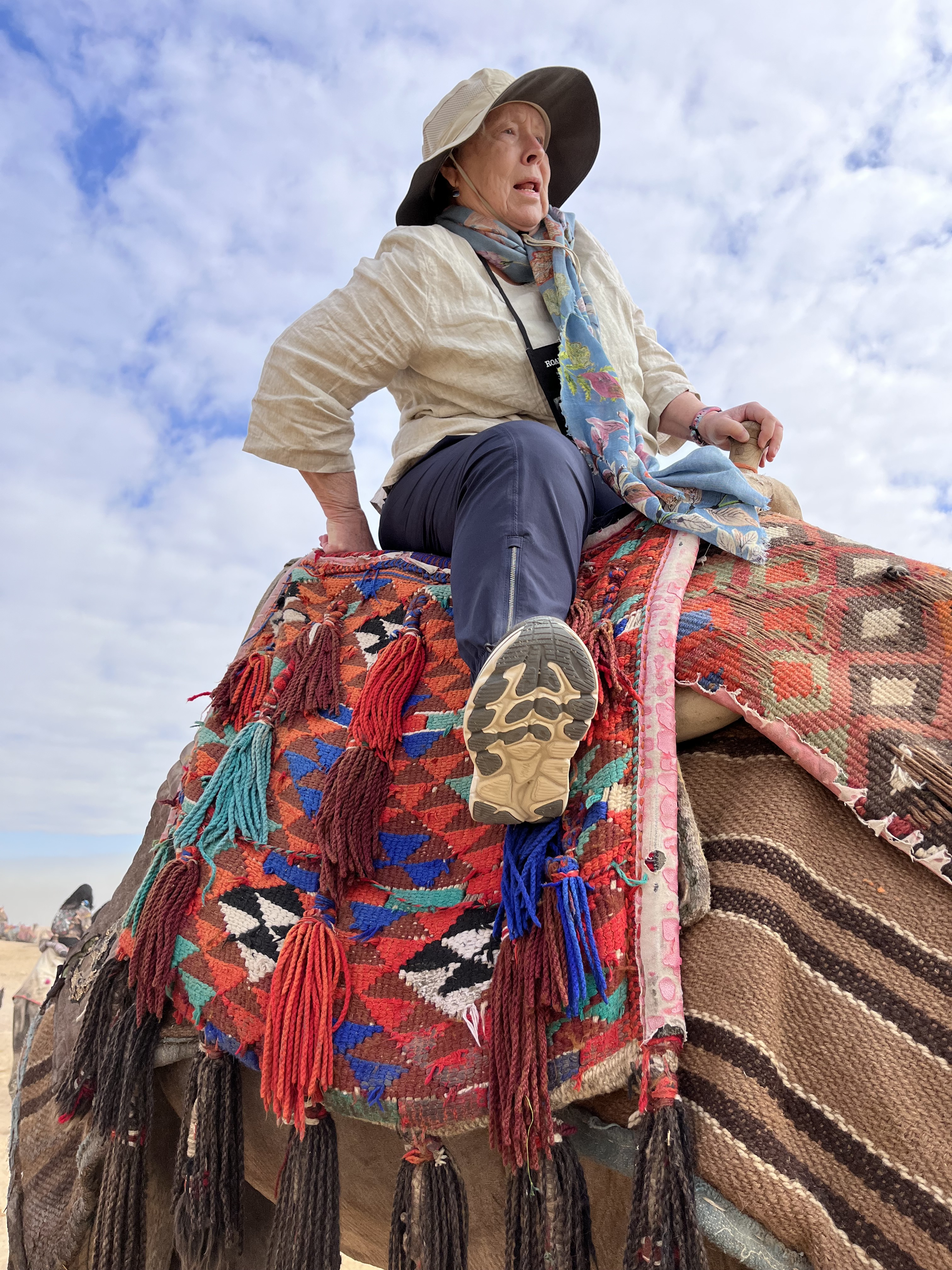
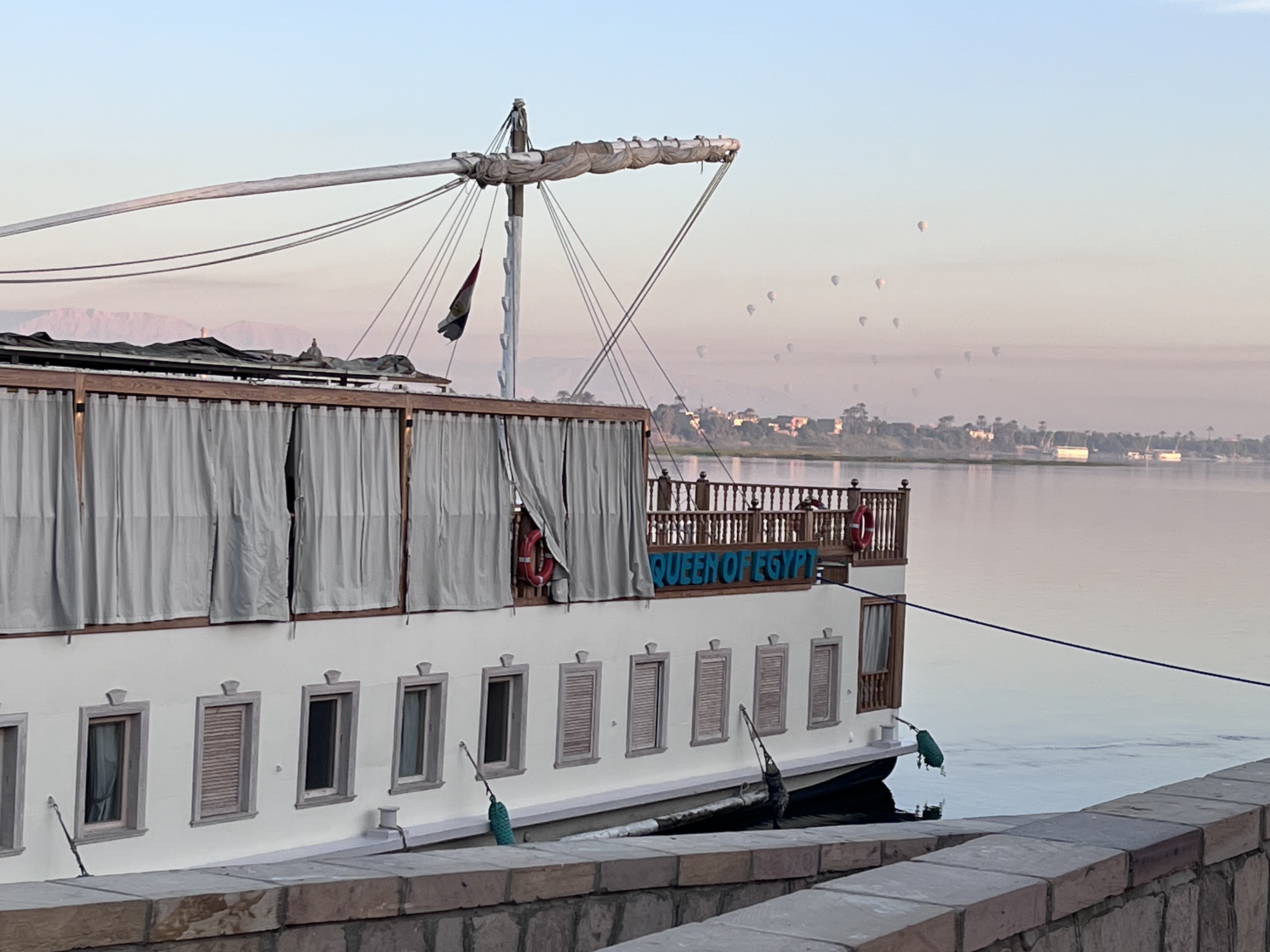
I could happily go back to Greece, as there is much to see and I barely scratched the surface. Italy has been rescheduled for next spring. Now I’m anticipating Egypt. Cairo and the Grand Egyptian Museum. The pyramids and the Sphinx. Abu Simbel, Luxor, the Valley of Kings. Sailing the Nile on a boat and envisioning Amelia Peabody! I can’t wait!

Later in the year, I’m planning a return to England and France. In keeping with my interest in history, especially World War II history, I’ve signed up for an Operation Overlord tour that starts in London, with the planning of the D-Day invasion, and includes visits to Churchill’s War Rooms and the Imperial War Museum. Then to Bletchley Park, where Allied codebreakers cracked the Axis codes. From there to Portsmouth and a cross-channel ferry to Normandy and the D-Day beaches.

Of course, if I’m going to England and France, I’m spending extra days in both places. Versailles, a tour of the Paris Opera, perhaps another trip to Giverny. As for England, I’m checking to see what plays and musicals are playing in London’s West End. The Museum of London, one of my favorites. The British Museum, a must. Afternoon tea at Brown’s Hotel, of course. That’s where Agatha Christie always stayed. And it’s the scene of her Miss Marple novel, At Bertram’s Hotel.

After that? Where shall I go next? Vienna? Australia? Costa Rica? Iceland? Spain? My wish list gets longer and longer!

And yes, there’s an art history plot in here somewhere. Remember, in my latest Jill McLeod/California Zephyr book, Death Above the Line, a Vermeer looted by the Nazis appears—then disappears. What happened to it? Eventually I’ll have to find out.

I’ll Take the Bad Boys

It’s no fun writing about Mr. Perfect. I mean, how boring can you get? Give me a character with some flaws and foibles, and I’ll write you a hell of a story.

I like the bad boys. The guy with the black leather jacket, the sleeve tattoo, and the don’t-mess-with-me attitude. The guy who is all dark and damn-your-eyes—and yes, I stole that line from Mary Stewart. Wildfire at Midnight, check it out.

I give you the Phantom of the Opera, from Gaston Leroux’s novel all the way through Andrew Lloyd Webber’s version. The Phantom is obsessed with soprano Christine and wants her for his own. He’s manipulative, strangles people with his Punjab lasso, and drops a chandelier onto the stage at the Paris Opera. Still, I’m rooting for him instead of that insipid good guy Raoul, the Vicomte. Really, Christine, he has a title and money, but you’ll be bored within a year. The guy who wears the mask is far more interesting. Sings better, too.

The flawed characters are the ones that make stories interesting. Think Sam Spade, who has an affair with his partner’s wife. Sherlock Holmes, with all his maddening quirks. Edward Rochester in Jane Eyre. He proposes to Jane while his crazy wife is locked up in the attic. Bigamy—now, there’s a bad boy.

I’m working on a historical novel about the Lincoln County War in New Mexico. Among the major players in that conflict—Billy the Kid. Talk about the quintessential bad boy. It’s been nearly 150 years since Billy blazed across the scene, but he still fascinates. He was not dark and damn-your-eyes—most accounts describe him as slight of build, fair, with blue eyes. He definitely had the don’t-mess-with-me attitude. He killed people, rustled cattle and horses, and primary sources indicate he was loyal to his friends, polite to ladies and enjoyed dancing at local get-togethers. I’m having a ball writing about him.

In Kindred Crimes, the first in my Jeri Howard series, there’s Mark Willis, an ex-con who did time for murder. Jeri knew him briefly in high school. Working on a case, she seeks him out.

Now life had aged him for real, streaking gray through his dark hair, etching lines at his eyes and mouth. There was something else, despite his grin and the flirtatious glint in those blue eyes. Something dangerous, a knife edge honed by twelve years in prison.

In a later Jeri Howard novel, Where the Bodies are Buried, Jeri goes undercover at the corporate office of a local company. She encounters David Vanitzky, who calls himself “a coldhearted, corporate son of a bitch.” He’s cocky, self-assured, and tells Jeri he’s the man with the shovel, the one who knows where the bodies are buried.

I had fun with a scene at the Oakland ferry terminal, where they don’t want someone to see them. David makes sure that their faces are hidden by grabbing Jeri and kissing her.

He had a soft mouth for such a hard case. I kissed him back, feeling a surge of guilty pleasure. I hated to admit it, but David Vanitzky was bad-boy sexy. The lure of the guy with the dangerous smile was, for me, somehow more attractive than the safe guy next door.

I put both hands firmly on David’s shoulders and pushed him away. . . .  “You enjoyed that way too much.”

He grinned at me, unrepentant, like a cat who’d had too much cream and figured he deserved it. “So did you, though probably not as much as I did. And you’ll never admit it.”

I liked David so much he puts in an appearance in the next book, A Killing at the Track. He likes to gamble on horse races. Are you surprised?

So, here’s to the bad boys. I enjoy writing about them and I hope you enjoy reading their adventures.

Serendipity on a Train

I thought about using Strangers on a Train as the title for this blog post, but it’s already taken. Still, serendipity is a better term.

Last month, I took the Amtrak version of the California Zephyr from the Bay Area to Reno. My ultimate destination was Carson City, where I visited a friend. The trip takes about six hours, and I always enjoy looking at the scenery as the train winds its way through the Sierra Nevada.

When the time came for lunch, I made my way to the dining car. As I ate my salad, I talked with the man across from me and discovered we both had degrees in journalism. In fact, he had worked for the San Francisco Chronicle from the mid-1970s until retirement a couple of years ago.

Serendipity, indeed. Why? There’s a character among the many fictional people who live in my head and in my fiction. Her name is Maggie Constable. She first appeared in in my novella, But Not Forgotten, and again in the latest Jeri Howard novel, The Things We Keep. Maggie’s backstory is that she worked for the San Francisco Chronicle in the 1970s.

As she says in The Things We Keep, “I started working for the Chron just in time for the whole Patty Hearst circus.”

Maggie has been demanding her own book for quite some time. I have at least two, maybe three, plots in mind for her. So, to meet someone who did indeed work for the newspaper in the 1970s is great. You can be sure I acquired contact information for my lunch companion.

More evidence of serendipity on a train: in 2010 I was researching the first Jill McLeod California Zephyr mystery, Death Rides the Zephyr. The old CZ, which ran from 1949 to 1970, took a different route through the Sierra Nevada, going from Sacramento to Oroville and then up the Feather River Canyon. I found out about a special train going that route, pulling all sorts of classic rail cars. The train was going to Portola, site of the Western Pacific Railroad Museum, for a local festival called Railroad Days.

I signed up and opted to ride in a Pullman car that had seen service on the Union Pacific. In the roomette across from me was a man who told me he was a graphic artist as well as a rail fan. When I told him about the book I was researching, he said, “I want to design your cover.”

Indeed, he did. His name is Roger Morris and he designed the covers for all four books, covers featuring nighttime scenes of the train cars.

I also met three other people on that particular railroad car. We called ourselves the Pullman Pals and took another train trip together, from Los Angeles to San Diego in the same car, which involved the interesting experience of spending the night in the Pullman car in the middle of the vast Los Angeles rail yard. I’ve stayed in touch with one of those people over the past 15 years. In fact, that’s who I was visiting in Carson City. We rode the Virginia & Truckee Railroad Company’s historic train from Carson City to Virginia City, pulled by a steam locomotive, riding in a vintage passenger car.

More serendipity? Well, yes. In my historical novel, still in progress, my protagonist rides a train. Seeing those vintage rail cars definitely gives me ideas about her journey.

All aboard! You never know who you’ll meet on a train, and what sort of creative ideas that journey will inspire.