Escaping the Summertime Blues

It is no secret; I have the summertime blues. I can’t seem to keep my mind on anything but the heat. And it is hot. Over a hundred here today. And likely where you are as well. There is a little cooling coming. And moisture. Tomorrow will be like a sauna. I tell myself, at least I’m not being evacuated from Rhodes.

Yet, the images from Greece make me consider books I read as a girl that filled me with images of places I couldn’t even imagine. And, yes, I blame books for leading me by the nose and eyeglasses into the world of writing.

Margaret E. Bell’s Watch for a Tall White Sail took me to the Ketchikan Peninsula in Alaska at the end of the 19th Century. I read it as a pre-teen and have never forgotten it or the ending. I can close my eyes and see the peninsula as it was then, the hardship of the heroine’s life, and her ultimate joy. I checked it out of the school library then and now wish I hadn’t. The book is only available in hardback and is priced over $100 dollars. I do drool on its Amazon page from time to time, then remember the joy of the second of three books, The Totem Cast a Shadow, and wonder if it is available. Not on Amazon, but anywhere. Which is the long way round to say, I’ve been on my way to the Ketchikan ever since.

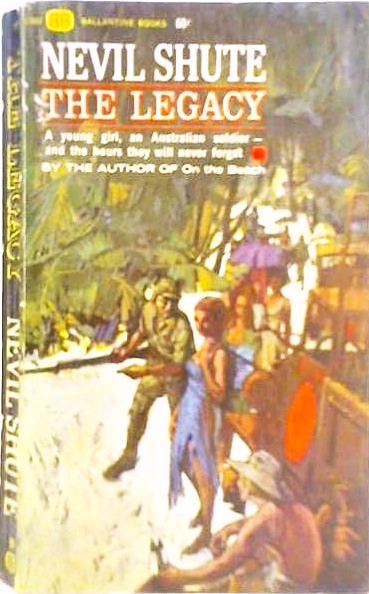
I fell hard for Australia. What I was doing reading Nevil Shute as a teen is an interesting question. My older sister wouldn’t let me near her copy of Exodus as in her judgment I was clearly too young for the contents of the pages. I snuck my mother’s copy and read it anyway which is why I am certain Paul Newman was the wrong guy to play Ari Ben Canaan in the movie. A bit off topic, so back to Nevil Shute. I read The Legacy before it became A Town Like Alice and have been on my way to Australia ever since, just like the sheriff James Garner played In Support Your Local Sheriff (a truly engaging, funny movie).

Which brings me to James Michener. Until They Sail fed my Australia problem and the movie by the same name did nothing to deter it. (Paul Newman was in that, too.) I’m not as old as it may seem, my parents used to take my older sister and me to the drive-in in our old turquoise and white Nash with the Nash seat. They picked double features expecting us to sleep during the second more adult movie. Fat chance. I still start crying at the mention of Sayonara and have yet to recover from William Holden’s bared chest in Picnic (not a Michener story but a great chest nevertheless). Inspired, I read Sayonara. I cried so hard at the ending that the pages in my copy are still crinkled where my tears dried. The Bridges at Toko-Ri, which I read when far too young, did not inspire a visit to North Korea, but Tales of The South Pacific and later Hawaii gave me the desire to see the islands. And I have. Even Lāna’i.

I pounded my way through From Here to Eternity. Don’t ask how I got my hands on a copy of it when fifteen. But I did. I am still in recovery from that book. And, yes, I have been to the beach. And, no, I did not reenact any scenes that once involved Burt Lancaster and Deborah Kerr.

All this rambling is to say, that as we write and world-build, we inspire others to travel, we help them see the world more fully, and sometimes we make them cry. And — books are a wonderful, magical way to escape the heat. You don’t have to be trampled on your way to the Acropolis or ferried from fires in Rhodes, rather you can luxuriate on Corfu or Crete or Delphi with the help of Mary Stewart. Or even on Barbados in my book Perfidia .

Check my books out at D.Z. Church – Author, Standalones & Vietnam Era Military Thrillers (dzchurch.com)

The Pitfalls of Near History

Most of my books involve near history. That means, at any given time, someone might read a book I have written who lived in or visited the place where it is set, at the time it is set, and who remembers what it meant to them. Making near history a bit of a minefield. With historical fiction, the author takes us back to a time that we know from various historical sources. But near history, well, we lived through it.

For instance, CDR Byron Cooper is stationed at Alameda Naval Air Station in Head First. The air station has since closed. But in 1972, it was the boom and the bane of life in Alameda, CA. People remember the bustle, the jets flying over, the massive gray aircraft carriers at anchor. And the view. The Air Station was a vibrant organism then, not the runways with weeds growing through them, housing developments, and shopping centers of today. For those who remember, it is my job to reflect the energy of it as they remember it. For those who don’t remember it, the job is to create an image of it as it was. The difficult part is avoiding dissonance for one set and creating a breathing organism for another.

Pay Back, the third book in the Cooper Quartet, charts the fall of Saigon, day by day. The surrender and the U.S. exodus packed an emotional wallop for the country. People remember where they were, what they were doing and how they felt. You don’t want to get it wrong. Placing characters into the events and sharing the emotion of the moment is an honor and a tightrope. Get it right. The Cooper Quartet charts the emotional journey of a Michigan military family. Consequently, Pay Back is set in Saigon, on an aircraft carrier on Yankee Station, and in Michigan. Getting the timing right across all these locations was a challenge but essential. I was dealing with near history, history people remember, some from newscasts, some from demonstrations, some from the killing field.

My book, Perfidia, takes place in Barbados, shortly after its independence from England. The population of the island consists of the descendants of blacks brought over during the slave trade, and lily-white British landed gentry. Read Jane Austen’s Mansfield Park for a frame of reference. Since then, the gene pool has been generously stirred. Yet, in 1972, when the story takes place, it was still better to be a landed white Barbadian than a black Barbadian with a folding house. In the book, one of the few remaining Barbadian plantations is at stake. Three men vie to inherit, one is a little bit Latin, another lily-white, and the third is mixed race. So, as historical fiction, it is essential that the plot address the subtle prejudices of the time. People remember.

When the story takes place, Sam Lord’s Castle is a fixture of the island. It burned down a few years after. People who visited after never saw the castle, for those who visited before it was a treat. Don’t get the par terre wrong, or the staircases, or the type of plants or the view of the ocean. You’ll hear about it.

Near history. Challenging. Although historical fiction of any sort carries its own dangers. The history we rely on was created by contemporaneous historians, revisited, and reinterpreted repeatedly by more historians, reported by the daily newspapers of the era, and defined by biographies and interpreted by encyclopedias and textbooks. Many of these sources have or had prejudices, ideas they wished to put forward, and axes to grind. Was General Bedford Forrest a tactical genius or a beast?

So, there you go. Historical fiction of any sort – near or long ago. Challenging. I had a reviewer tell me a character knew nothing about how hard women worked in the 1870s as though she had firsthand experience. She must be very old indeed. It is enough to make you write a contemporary detective series.

Nope, not for me.

Writing Good Grief

I was recently reminded by my own ineptness that the grief of loss has no timelines. Nor should it in telling a tale, most especially a tale of murder. For each murder done, someone grieves for the dead, be it the detective, the killer, or the friend. And this grief displays itself in action, the resolve to find the killer, the need to hide motive, and, perhaps, revenge.

The protagonist (detective or innocent) is called upon to develop a relationship with the dead whether the loss is personal or not. As the protagonist wades through the suspects to resolve the central mystery, each character brings their hurt with them. They have all suffered a loss and so are at some stage: shock, denial, anger, bargaining, depression, and acceptance/hope. Since each step along the path takes as long as it does, any given character may be in any stage at any time, offering endless possibilities to the storyteller.

The framework of grief is one piece of the scaffolding for my military family saga The Cooper Quartet. In Dead Legend (Book 1), two boys are left adrift by their father Mac’s death. The oldest son, Byron, sixteen when his Navy pilot father dies, quickly moves on to bargaining while keeping one foot firmly planted in denial. The younger son, Laury, hits anger and stays there for twelve years. Each of the four thrillers in the saga moves along the continuum of loss toward growth and forgiveness.

From Dead Legend: Navy Pilot LT Byron Cooper

“Let’s get out of here.” Byron shucked dollars out of the right hip pocket of his slacks as he stood.

“Mac doesn’t come to you?”

Byron grabbed Chloe’s arm. His hand felt hot on her flesh. “Yes. Tonight—with you—with everyone. Happy now?”

Marine First Sergeant Laury Cooper

Laury took the photograph that Vincent held out to him. He put two fingers between a pair of cigarette smoke caked blinds to let a ray of sun splash the picture. His eyes locked on the blood smeared down the leather bucket seats of Mac’s MG and wouldn’t let go. When the shock passed, he fixated on Mac’s right hand extended as though he had been gripping the gearshift knob the moment before. Laury’s hands shook, sweat rode up his back and down his armpits. He ran a hand over the lengthening stubble on his head.

Grief is not simple. It is recurring, a memory at the oddest moment, a moth in the morning. It is not a thrown-off phrase (My fiancé died in the war). Loss haunts us, it should haunt characters as well impacting their judgment and actions.

From Head First (Book 2):  LTjg Robin Haas (their cousin)

She clamped the rounded pewter ends of the POW bracelet she wore tighter on her wrist then traced the name and date with her fingers, LT Harry A. Stillwater, 10/5/68. Four years, two months, and fourteen days, in that time he had been Killed in Action, Missing in Action and now was a Prisoner of War. At least, they thought he was.

Who really knew? Robin had gone to North Dakota to Harry’s funeral, sobbing with the sisters Harry adored, the mother he treasured and the father he idealized, trying the while not to crawl into his empty grave. Yellow roses made her cry. A-6s made her cry. Even Gunner, their tabby tom cat, made her cry.

Throughout it all, characters must remain true to themselves. Good grief in a story might be silent to raging but it must always be organic. And in so being, the character’s action or reaction to any element may surprise, revealing a new facet or changed state that alters the reader’s perceptions and the resolution of the story.

From Don’t Tell (Book 4): Kate Van Streain Cooper (Laury’s new wife)

Each afternoon, she checked out a chaise from the nut-brown beachboy at the kiosk as he ran his eyes down her long limbs. They would skim over the inked drawing between her shoulder blades, still fresh after a week, and follow the Chinese characters tattooed on her spine to her dimple. Feeling admired, she languished by the water in her chaise, alternately reading Michener’s Hawaii and dozing. She opened her eyes at each passing shadow expecting to see her husband smiling down at her, his azure blue eyes blazing beneath his long dark eyelashes.

Good grief hovers below the surface of the plot, providing motivation and color. It remains just out of reach, shading the past and the future. A character in its own right. In The Cooper Quartet, it takes two brothers four books to come to terms with their father’s loss. In the process, their lives are changed forever by the Vietnam War and the actions they take to protect each other and their families.

My adventures with AI or …

The movie War Games has been stuck in my mind for, what? Forty years? And having worked in the nascent modeling of meteorological data, I know that prediction is only as good as the data accessed and the decision tree established. By humans. Humans, too, build AI models. Meaning at some point, computers will take over. I know this, because of War Games, I Robot … the list is long.

That said, as a writer, I find creating marketing and cover copy difficult. This should be some sort of weird joke since I toiled in the advertising trade for years writing copy. But here is the issue — when writing about plums or kiwi fruit you are writing about something with which you have no emotional attachment.

Not so with your book baby. I find it disconcerting to write something like this: (Any book) is an action-packed and heart-wrenching tale of family, friendship, and loss that will leave readers captivated until the very end. I don’t want to over-hype, I worry about readers being disappointed when they aren’t captivated. I worry that someone will notice my baby has a big ____ (fill in the blank).

So, I reviewed several AI programs that touted their book marketing capabilities. Decided, I took advantage of a free trial offer from Anyword (the above is an example of the output). Here’s what I discovered. The output is only as good as the input. No kidding, the more honed your sales points are, the better the output.  Duh!

Anyword’s user interface is easy to navigate. Having selected the Amazon landing page option, I entered my bullet points. Three versions of AI-generated text popped out (you can pick fewer). Cool. I did this for my new book Unbecoming a Lady, then my series The Cooper Vietnam Era Quartet. Other than the glee of hitting a button and having words magically appear on the screen, I benefitted most immediately from some great closing sales pitches. But the landing page copy generated always required editing. Some of the text output was downright funny and once a bit scary. So, it takes time to edit the output, just as it takes time to develop the input for your book(s).

Further after three or four pitches, I noticed a pattern. The book was always exciting, wonderful, thrilling, suspenseful, ____ (fill in the hype word). You get the idea. Since the program (all AI programs) searches a database of successful like-product pitches, the text can be robotic and derivative.  In fairness, the blurbs do match every other Amazon sales pitch, including that for cat watering stations, light bulb changers, and, well, everything. Based on the language errors made in Anyword and errors seen on Amazon, I suspect AI, including Anyword, is used by many marketing firms to create pitches quickly with little editing.

In the end, your AI-generated book description is no more exotic or exciting than any other book’s. Good or bad? I don’t know. My years in advertising tell me no. This means, to stand out from the competition you will need to do more honing. And, yes, research.

My Conclusions?

Using AI to create book sales copy is freeing in that it gives you a totally non-human, unbiased swag at your book. A place to start. But it isn’t a time saver. Maybe an ego saver, if it saves you from hanky-wringing angst while writing the hype for your book baby.

Anyword has a hefty subscription fee, enough to give one pause, though it would give you the ability to endlessly redo your landing pages. And that is attractive, despite the little voice whispering: For crikey sakes, you worked in advertising. Yes, still?

As you can see, I’m undecided. Though, I admit I worry AI will soon write us all out of business. Remember, War Games haunts me.

Down to One Last Charge

Eight days! Stuck behind a mountain of snow. Our prize oak tree split and embedded in our car, stranding us. We were down to one charge on one power pack for one phone (our only lifeline) when power was restored.

Imagine no power for eight days. In the mountains that means no heat, water, lights, or flushing toilets. Oh, we had enough food. I went shopping two days before the storm as did everyone else in the area. I was standing, resting my elbow on my shopping cart’s handle, when a woman in another endless checkout line yelled, “It better snow!” 

It did. Feet of it. It was enjoyable, big fluffy flakes softly piling up on our deck, until a tree demolished our car, and the power went out. After that, we had no way out, nor did our neighbors. We have an excellent wood-burning iron stove and dry wood. We could light our gas stove with matches, but not the oven. We had headlamps, and lanterns of all sorts. Batteries for the ages. Puzzles. And a massive goose-down comforter in the unheated bedroom. We believe the ambient temperature of sheetrock to be forty-four degrees.

Now, if you’ve been paying attention, you know my most recent book Unbecoming a Lady takes place in 1876. That’s where we lived for those eight days. It’s tough. But what I learned is this, it can be done. It takes some reorientation, for sure. On the first day, you figure out what is essential, and how to operate all while praying that the power comes back on. You overuse your phone because it is your only point of contact with the outside world. And, in our case, the only way to file the insurance claim on our destroyed car. Oh, for a horse and sleigh like those used in Cora’s little prairie town of Wanee.

Then you get the endless emails from PG&E telling you they are on site and the power will be up Monday … no Wednesday … no Friday.

As time went on, we ate the food from the freezer in the order it thawed. We ate pretty darn good. One night we dined on coconut shrimp and dim sum. Way better than Cora’s winter mainstays of storage vegetables and salted meat.

We lived Cora Countryman’s life for over a week minus the three-story house to clean and the boarders to feed that define her days. Hard, all-consuming work. All your attention turns to staying warm, clean, and fed. You get up in the morning and light the fire, boil water to make pour-over coffee, scramble eggs, and fry bacon. Forget the toast. Then you gather fresh snow for your coolers and dump water in the toilet tanks until they flush. You melt snow and boil it to wash yourself and the dishes. Put fresh batteries in where needed. Shovel a path through the snow to the wood pile. Then shovel it again. Pull out the old laundry drying rack and set it by the fireplace, so everything is dry for the next day’s shoveling. You get the idea. And when it gets dark huddle around the fire with your puzzle. Then repeat.

My husband and I finished the puzzle, headlamps on our heads. It is striking how well we adapted to life without television, streaming, phones, lights, toilets, running water, and a microwave. Perhaps because games were played outside when we were kids, the telephone was tethered to the wall, and the television was a small square box with three channels. This isn’t to say that we didn’t delight when the microwave went diddle-diddle-dee, happily letting us know the power was back on.

Now, like Cora, I wonder how her mother found time to play Whist three days a week. And I have a deeper understanding of her day-to-day life. Now to write a wintertime mystery!