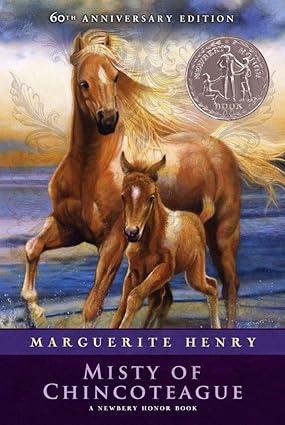
Where Reading Leads: Misty of Chincoteague and Me

I ask you to come along on a tale.

I first read Misty of Chincoteague when I was eight, which led me to consume Marguerite Henry’s books like a box of chocolates, one rich tale after another. Misty of Chincoteague; Stormy, Misty’s Foal; Sea Star; Misty’s Twilight. I moved right on like a vampire sucking the good bits out of each book. My older sister begged for horseback riding lessons, which later defined her life. We had plastic ponies. We were goners.

Of course, as my taste became more sophisticated, I moved on, my plastic pony forgotten on a shelf. I admit that my Skipper doll used it as a prop for a time. Fast forward, oh, say, thirty years.

I am in charge of a handscoring center in Maryland that employs 400 Maryland teachers and 50 staff from my company in California. We have two months to score multiple grades of student writing samples for all students in those grades. Each sample must be scored twice holistically, then analytically by multiple teams of scorers. I won’t go into further detail. Just know it was a colossal task.

Fast forward again. My second in command and I hadn’t had a break in weeks. We made it to our rented townhouse in Randallstown every night around eleven, drank wine, ate bread and butter pickles, cheese and crackers, and topped “dinner” off with ice cream. At six a.m., we drank coffee and then headed to Baltimore and the rented building that housed the scoring center.

After weeks of this, we had nothing to do one Sunday. On a lark, we went to the Double T Diner on Route 40, where ‘Diner’ was filmed. Over a Greek omelet, my coworker looks up at me, I at her, and our voices overlapping, as in what goes up a chimney, we both say, “Misty.”

We finished our omelets, got in our rental car and headed south for Assateague Island. No more thought. Well, we wondered why the bridge from Annapolis to the Eastern Shore was so crowded with cars going west. And once, as we turned onto a county two-lane, we saw a flashing sign. Something about a hurricane warning. A warning, nothing more.

The draw of Misty was such that we kept going, and going, until we crossed the bridge to the barrier island of Assateague. A 37-mile-long strip of land between Virginia and the Atlantic Ocean and home to Chincoteague ponies. The gates to the park were wide, and the booth unmanned. We did see signs explaining that the ponies were shy, and visitors often went home without sighting one.

Not us. Ponies were everywhere up the spine of the island. One was raiding a camper’s tent. Others stood in groups, foals between them, their backs to a growing wind. We tumbled out of the car in awe. Two well into their thirty-year-olds suddenly eight again, our mouths agape as illustrations from the books flashed by.

A park ranger pulled up next to us in his truck, and like eight-year-olds, we explained we were just looking. He shrugged, looked at his watch, and said, “The hurricane is due to make landfall in two hours. The park is closing. It looks like a bad one.”

The sky was slate. The wind whistled, clouds churned and boiled. It hit us then that we weren’t lucky to see the ponies; they sought high ground!

We got in the car, our hearts full of Misty, and drove like Hurricane Bob was on our tail. We took secondary roads, breaking into a long line of families evacuating, everything they cared about strapped to the top of their cars. It took hours, the wind increasing, the sky purple and dusk growing.

We crossed to Annapolis in a phalanx of cars, horns honking, a sight not unlike any disaster movie. We made US 97 north amid falling trees, downed power lines, and rain like none we had ever seen. It hit the earth and bounced five feet back into the air, drenching everything on the way down and back up. Leaves torn off trees, their stems intact, got stuck in our windshield wipers. We detoured around downed trees and wires until we made Randallstown. Soaked through to our very selves, we clambered into the townhouse, laughing.

A half-gallon of rocky road ice cream with chocolate syrup later, we were still laughing at the Thelma and Louis of it all and those ponies! Oh, my!

And that, my friends, is where the evil of reading can lead you. To joy, adventure, and beyond!

History “swings like a pendulum do” *

* to misquote Roger Miller’s “England Swings.”

When selecting a year in which to begin my Wanee Mystery Series, I landed on 1876 not by accident but by design. It was the U.S. Centennial year. The Centennial Exhibition in Philadelphia, partially powered by a massive steam engine, showcased Alexander Graham Bell’s telephone, the first typewriter with a QWERTY keyboard (Remington 1), Edison’s automatic telegraph, new products such as popcorn, ketchup and root beer, and mass-produced wares including an improved sewing machine. Attending librarians founded the American Library Association. The women’s pavilion demonstrated women’s influence in philanthropy as well as philosophy, science, medicine, education, and literature, foreshadowing the woman’s movement. All while, Reconstruction was still a thing, Native Americans were battling for their land, the James brothers (and others) were robbing banks, and the country was fraught with the second worst depression in U.S. history, setting men adrift to join those already on the road due to the Civil War.

The War may have been over, but it wasn’t. The tides of belief were changing in the North to be less tolerant of the blacks they had just freed. The Southern Democrats fought a different sort of war using intimidation to ensure victory at the Southern polls. Lynchings were common, murders as well, all over the country, not just in the South. The country felt out of control to most. Yet the depression was easing, opportunities were appearing, and technology was booming. Does any of this sound familiar?

What I didn’t expect was how the next year, 1877, the setting for books four through six, would mirror the present. Newspapers predicted the fall of democracy. Public sentiment turned against “tramps” (homeless to us), immigrants, and Hispanics north and south of the border. Southern Democrats (some of whom, as seditionists, the 14th Amendment denied the right to vote or hold political office) took over statehouses by force and threw out duly elected Republican governors, reclaiming control of the south. The oligarchs of industry ruled the White House and most state houses. Graft was everywhere during President Grant’s just ended presidency, and the election of Rutherford B. Hayes considered fraudulent.

Fear crept through the cracks in doors and across the floor, coloring daily life. Small towns were no exception. Though generally not central to the angst, their newspapers, fed by the larger dailies, amplified the news and worries of the world, breeding distrust of the government and outsiders.

The West was still wild, the East tame (if you call murder, gangs and lynchings tame), and the Midwest a mess of mixed sentiments especially in the border states. Small towns like my fictitious Wanee, Illinois were at the nexus of all this change, rife with the disenfranchised, pressured by growth of outside industry, the railroad, and farmers. Glory be, it is my job to weave the discomfit, prejudice, worry, and change into the warp of each story. What a wonderful and frightening opportunity.

The words of one of my professors accompany me; you cannot truly know the tale Shakespeare tells without first understanding the context of the time in which he wrote. He wasn’t a Shakespearean scholar though he discovered the first draft of one of Shakespeare’s plays. Even so, he taught us far more than Shakespeare. He held our hands through the Elizabethan period, the church, the mores, and Shakespeare’s competitors. He made Shakespeare new to me with one question: what if Hamlet’s father wasn’t dead? I hope I do him honor in providing the context for my tales, these roiling years are the stage upon which Cora and her cohorts play. I ask myself with each page written and each plot devised how this disquiet affects the day-to-day dreams and strivings of Cora Countryman, Dr. Philip Shaw, and Sebastian Kanady, who owns and edits Wanee’s newspaper.

This tumultuous period will provide me with plots for a long time to come as Cora and her supporting cast wend their way through to the new century solving the crimes I present them. Yet, as I work on the fourth book, it feels as though 150 years on, we are fighting the Civil War all over again, while dealing with the same threats to our future, oligarchs, seditionists, and technology included. I for one do not wish another 1877 on this country, nor should you.

But I do love writing about the era and how the changes it forced still define us – for the good or the bad.

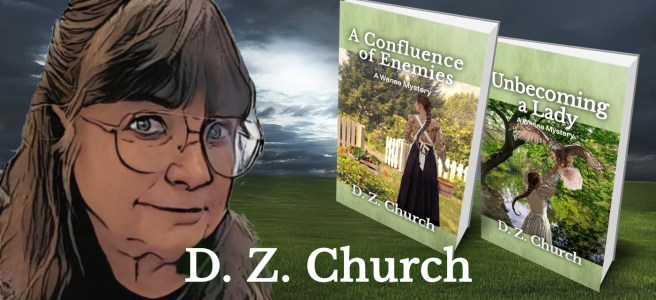
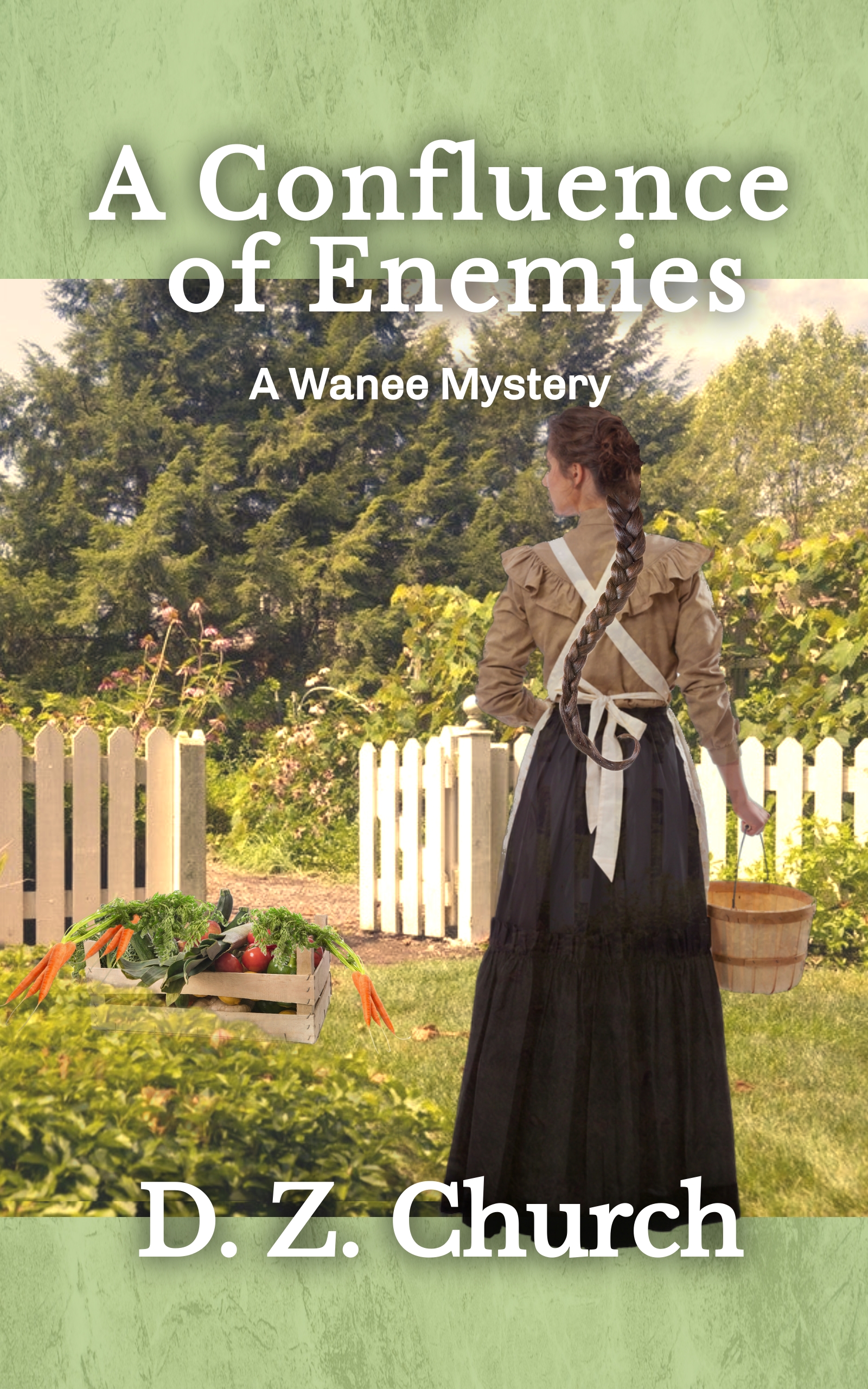
Unbecoming a Lady and A Confluence of Enemies are available from Amazon; https://www.amazon.com/Confluence-Enemies-Wanee-Mystery-Mysteries-ebook/dp/B0CQJ5DW4W. Check my website: https://dzchurch.com for more information on the Wanee Mystery Series and my other books or to sign up for my newsletter.

Five New Year’s Confessions

I’ve been scurrying around preparing for the January 15 launch of A Confluence of Enemies, the second book in my Wanee series. The fact that I’m scrambling doesn’t bode well for 2024.

And that’s not good since 2023 was a stinker. I think the earth has tilted too far, it seems darker at night than it used to and warmer outside, and oh, heck, what a mess. Resolutions for 2024, hardly. Instead, here are five things I confess need my attention:

Too Many People: I have a very crowded brain. I live in Wanee in my head and know all the preachers, teachers, and shopkeepers. And their children and grandchildren. I want my readers to know them, too. They’re great people, with their own foibles and dreams. But I need to be firm with them. You can’t be in this book! Maybe the next one — as the dead body — if you keep pestering me for your fifteen pages of fame. On the other hand, if you’re building a world for your readers, shouldn’t you populate it with characters readers want to watch grow? Sheesh.

Everyone’s name does not start with E. Note to self, just stop it. I carefully curate the names of my main characters, villains included, culturing their names like pearls. It is the rest of the folks that present problems. While reading the first draft of Of Waterworks and Sin, the future fourth book in the Wanee Mysteries, I discovered that all the female second banana’s names started with E. This makes some sense, since a century and a half ago the prairie was full of Ellies, Emmas, Ellas, Eleanors, and Elizabeths. As this is not the first time a letter has inhabited my mind, I need an alphabetical list of common first names for the era by my side as I write. Need, being the operative word.

The rhythm of the written word: I make sure the words used in my historical mysteries were in common usage when the books take place. And I attempt to follow the language constructs of the period, which were more formal and precise, leading to a deleterious effect on the simplest of descriptions. My first drafts are a hell of: the hat on the head of the lawman. Instead of the lawman’s hat, or better a black Stetson. The handle on the door. The roof over the porch. On a positive note, tending to these oddities results in more fulsome, precise descriptions. Or, so, I choose to believe.

Giant chapters. We’re talking humongous – up to twenty-two pages. I plot in days, not events. Days. Midnight to midnight. And since I’m writing historical mysteries, communication are slow … everyone is walking, talking, gossiping, visiting, leaving notes, clanking pots, making signs. None of this driving over in the car, dialing up the cellphone or texting the news. Wanee has a paper boy who delivers the daily paper. A telegraph office for news of the world. The local gossips at the dry goods store. Everything happens in person. That’s my excuse, dialog, getting to and from, moving through the labor of the day. In truth, I need to break my days up if for no other reason than to give my readers time to text someone about how much they are enjoying the book.

Stupid strange omissions. When will I get it through my head to include links to the preceding book in the series in my eBooks, or the series page, and in print in the print versions. How about my webpage? My newsletter? My Facebook page? My blog? You do it automatically, don’t you? I leave them off … everything … truly. What’s that about? So, here we go …

See, that wasn’t so hard, except for the Facebook part. Happy New Year, y’all!

The Art of Pumpkin Pie

Pumpkin pie is my favorite pie — hands down! Afterall, it is a vegetable and a pie! Like some of my books are thrillers and mysteries.

I come from a long line of ‘damn fine pie makers.’ One aunt has that exact wording etched in her tombstone. The best pumpkin pies begin with a luscious, heavy, ripe pie pumpkin. Thick meaty inside, easy to puree, with a heady pumpkin aroma. A perfect, light crust. Lots of nutmeg, to ease you into the after-turkey hallucination phase, but not too much. And heavy cream whipped by someone standing by with nothing to do but wait for the turkey to crisp.

When I was small, we grew pie pumpkins in a quarter acre truck garden on the family farm. Now we go to market or to a pumpkin patch with the sweet pie pumpkins relegated to the too small to carve but ideal to bake patch. Those who claim to know tell me the Dickinson pumpkin, an heirloom pie pumpkin, is the go-to pumpkin for cooking (Cucuribita moschata). I don’t know that I ever knew the name, just the weight, heavy for its size, not round but a wee tallish, with a little softness at the bud end. You want a pumpkin with firm texture, so the puree is thick. Watery puree mutes the taste of the pie.

The next step is, of course, to steam or bake the pumpkin until the meat is soft and tender and ready for the other ingredients to make it creamy, heady, and luscious. Now a days, you can take the stem out and pop in the microwave, saving untold amounts of time and guessing.

Every family – well, Midwestern family — has a pie recipe handed down from some past grandma. I’d guess most of the recipes use Eagle Brand condensed milk which originated in the mid-1800s and was a staple by the end of the Civil War. While Eagle Brand canned milk is credited with significantly lowering the rate of infant mortality, it is equally famous for fattening us all on pumpkin pie. I don’t know when the ubiquitous pumpkin pie recipe arrived in cookbooks, but I do know that in 1931 Borden’s offered $25 for recipes that used their condensed or evaporated milk and received 80,000 responses.

If you are making your pie from scratch, great grandmas everywhere advise baking the crust first to avoid a soggy bottomed pie. Like pumpkin pies, families passed down crust recipes and techniques from mother to daughter. Or, in my case, grandmother to granddaughter. My mother’s mother made magnificent crusts – pastries, of all sorts, would that I had her skill. Her crusts were truly flaky, firm, and tasty. I can still hear her advising to never overwork the ingredients. And she always had left over dough, taken from edges, or just more dough than pies. She used it to make pig ears. A pig ear is pie dough rolled in butter, cinnamon and sugar then coiled around itself and baked into a wonderful pastry, in case you didn’t have a Swiss grandmother with too much dough.

So, this Thanksgiving, I pause to genuinely appreciate the ladies in my past who baked in the old style, beginning with flour, fresh vegetables, fruits and meat, and the ever-useful measuring spoons on the ends of their wrists. As I write my historical mysteries featuring Cora Countryman and her cohorts, I rely on the lesson I learned in their kitchens to bring the demanding work, the sense of accomplishment, their dedication to my character’s lives.

Perhaps I’ll have Cora bake a pumpkin pie come fall 1877. Cora, of Unbecoming a Lady and A Confluence of Enemies (coming January 15), grows her own pumpkins in the garden on the corner of her boarding house’s lot. Her brother who runs a dairy co-op to the north of Wanee would supply the cream or she might buy a can of Eagle Brand at Layman’s Dry Goods in town. Cora will bake the crust, steam the pumpkin, mash, then whisk the pumpkin meat into puree, and add the cream and spices. The resulting pie would compete with her mother’s famous lemon bars. Her long-time boarder, the newspaper editor, and the new doctor in town would scarf it down, Doc getting whipped cream on the tip of his nose.

Happy Thanksgiving to all!

Cora’s adventures begin in Unbecoming a Lady, https://www.amazon.com/Unbecoming-Lady-D-Z-Church-ebook/dp/B0BTKBSP1B. A Confluence of Enemies, the second book in the Wanee Mystery series, is available January 15, 2024.

Wilted Daisies

Maybe it’s the darkness of the day, the brown leaves dripping with rain, or Halloween around the corner. Whatever, it conjures stories of visitors from beyond the veil. So, I offer a short-short-short-really short story for your October enjoyment.

No one had used the back parlor of Countryman House since the official government letter arrived twelve years earlier notifying Edith Countryman of her husband’s death at Chickamauga. The letter remained on the small table before the settee, held in place by a crystal vase of long wilted daisies.

As Cora Countryman entered the room, sunlight glissaded through two six-over-six windows, their red brocade drapes tied back to save the cloth, the open sashes allowing the soft clucks of chickens to invade the still of the room. Shelves of books lined the interior wall, some behind glass. When a girl, Cora sat at the carved mahogany reading table by the windows. Her feet dangling off the chair, her tongue between her lips, she drew pictures of sailboats, strange pyramids, and darkly clothed men from stories. Of course, that was when her father lived, before his loss forced her mother to take in boarders.

Twelve years seemed ample time to mourn, especially with her mother as gone as her father, though not as dead, well, not dead at all if the rumors that Edith was gambling on the Mississippi riverboats were true. Cora leaned over, touching the letter’s brittle paper. As she did, the room shook under the thunder of hooves so real she pivoted to face them, horses leaped over a stonewall onto pikes, men shouted as others fell, screamed, lay motionless. She removed her hand from the paper, the room ceased shaking, all before her vanishing.

Cora sat on the settee, staring into the marble fireplace with its walnut mantle, her right hand spread across her chest, her breathing rapid. She lowered her hand to her side, afraid to touch the vase of dead daisies, lecturing herself on her ridiculousness.

Once convinced, she wrapped her fingers around the vase, a withered white petal fell from a long dead stem, floating to the ancient letter. Laughter erupted and swirled around the room. A young woman, a daisy chain wreathing her brow, threw her arms out, twirling until she bobbled into the arms of a dark-haired youth of near her age. They lay together in the tall grass; he brushed a single daisy petal across her lips, until the marching of heavy footfalls brought them to their elbows.

Cora admonished herself, she was a modern woman, this was fantasy, or wishfulness. She lifted the yellowed paper between two fingers, it tore along a long-rotted crease.

“He is not dead, he is not,” a man in a blood-spattered coat insisted, his hands at the wrist of the body set before him. “Take him elsewhere, he belongs with the living.”

A soldier, his blue uniform filthy, positioned the dead man’s arms on his chest and with another lifted the stretcher. The two ducked out the tent flaps into cannon smoke, bullets smacking into trees and through tenting. They dropped the stretcher and ran for cover before men in gray on wild-eyed horses breaching the position.

Cora’s father lay before her, blood coursing from his wounds. A smile eked across his handsome face, a sly one. He opened one eye.

The government letter of notification in Edith Countryman’s right hand, she sank to the settee, placing the letter on the table. When a breeze ruffled the paper’s edges, she situated a vase of daisies on it. “He is not dead, I have seen him, I have seen his smile.”

The vase and letter remained there, twelve years, her mother forbidding all to use the handsome room. Determined to end the nonsense, Cora took the cut crystal vase of dead flowers in one hand and the yellowed notification in the other to the paned-glass section of the bookcase. The moment she set the items on a shelf, it began to vibrate and the glass panes to shimmy. She slammed the rattling doors closed, and holding them tight with her left palm, she locked the haunted souls inside. The key tight in her fist, she leaned, her back against the shelves. A wind howled down the fireplace flue and across the floor, swirling ashes over and about the table.

Her eyes on the fluttering ashes, Cora took a deep, freeing breath. There were eggs to collect.

Cora’s adventures begin in Unbecoming a Lady, available at https://www.amazon.com/Unbecoming-Lady-D-Z-Church-ebook/dp/B0BTKBSP1B. A Confluence of Enemies, the second book in the Wanee Mystery series, is available January 15, 2024.