Once Upon a Summer Island Thriller

It’s summer, the heart of it; fireworks have filled the sky, and the heat has set in like a hot pad on high. The grass has turned lion’s mane bronze punctuated by the yellow of blossoming mule ears. It all makes me long for a trip to my husband’s family’s cabin on an island in a lake in Ontario, Canada. It is a magical place, saved from dereliction by my husband’s mother. She paid the taxes due in the early days of the prior century.

I once charted 19 species of trees and bushes on the three-acre island a buzz with bees and even the stray firefly. I have long believed it is like no other place on earth. As an island, it is of endless curiosity to those boating on the lake. What, then, does one do to ensure the random visitors who climb the island respect it.

In a stroke of brilliance, the door to the cabin was left open, and a Red Chief pad was set out on the dining room table for those who visited to write their names or leave a note. There have been a few incidents, but very few over the nearly hundred years my husband’s family has shepherded the place.  

And, yes, visitors left notes, years of them, whole histories of those who picnicked with their children, who returned as teens, announced their marriages, and returned to picnic with their children. A history left in pencil on foolscap.

Then there are the Canadians who have property on the same bay. Friends who look out for the place. I’m thinking of one group who, upon availing themselves of the island for a bit of the Canadian pastime of beer drinking, saw that a tree had fallen across the cabin’s roof. They returned, removed the tree, fixed the roof and left a note dubbing themselves The Green Bay Boys. I met them when alone on what appeared to be a deserted island, the guys had taken the boat to go into the nearby town (about 20 miles) for lumber. They trooped up with cases of beer to sit on the deck overlooking the lake. Spying me, they grinned, introduced themselves, and offered me a Labatts, which I did not decline.

The family across the bay, whom my husband knew from childhood, lived in the original stage stop, farmed, and managed a herd of spring kittens. They also allowed our family to dock and keep the boat and the engine in a shed over the winter. They are all gone now, and we truly mourn their passing. Such good friends and times.

And if you aren’t aware, Canadians are lovely, filled with fun, and a bit understated, eh? Our neighbors created a whole mythology about the island added to with wild abandon. A dentist who buried a body on the island. A mobster who flew in on a waterplane and held secret planning meetings. Sprinkled with tales of the horse-eating fishers, just to liven up the lies.

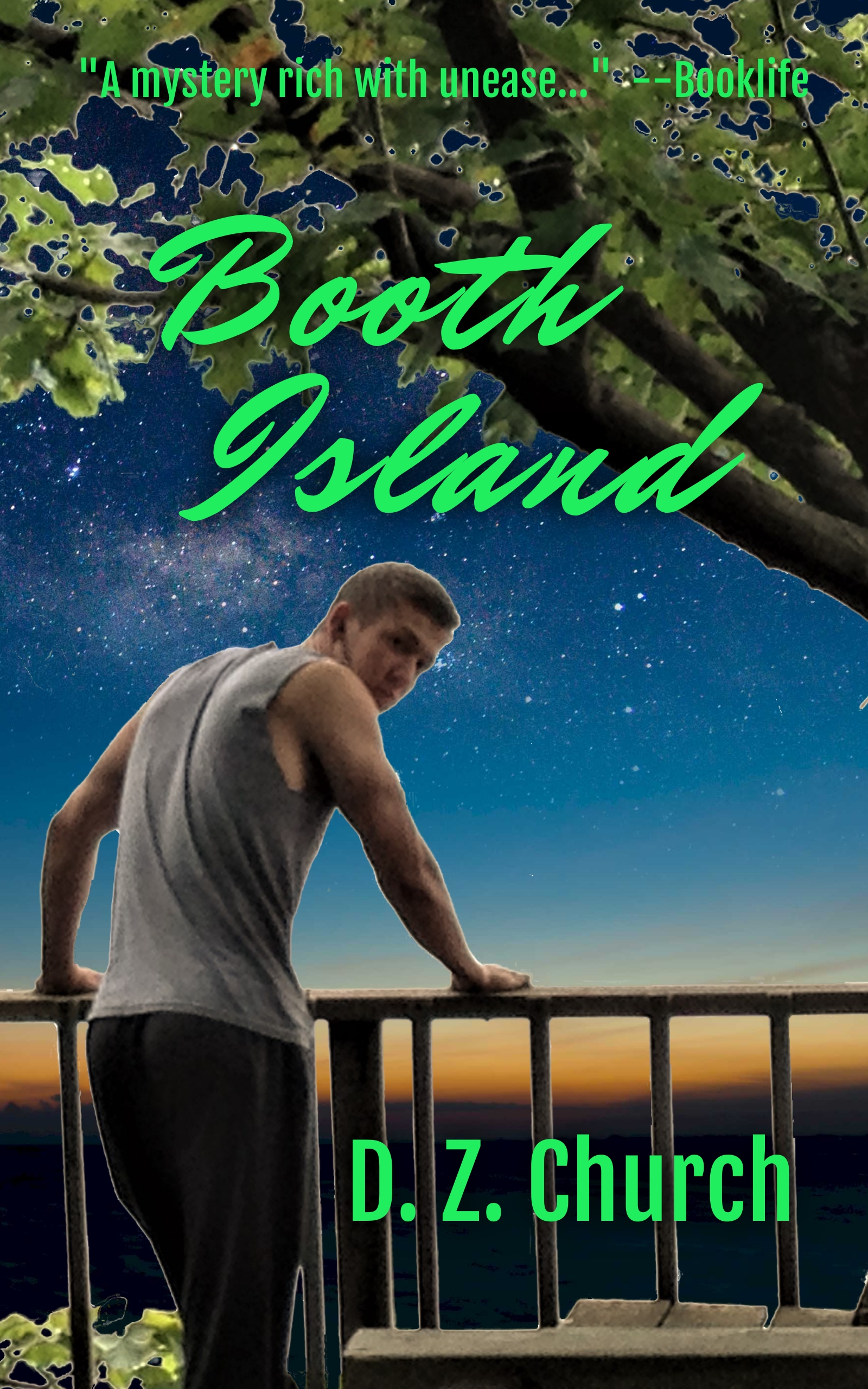
My great-nephew. His
dad’s snap of him on the island’s deck made the perfect cover.

Then it happened. A few years ago, I sat down to write a thriller and out popped a tale of the island. Booth Island was a blast to write, rampaging out of my head chapters at a time. When I was done, it had been nine years since Boothe Treader summered at her family’s island. Twelve since her brother died on its rocky shore. She never forgave him for abandoning her, her parents for divorcing, or the dark-eyed boy who watched him drown.

Then her mother deeded her the island. And old friends lined up to welcome her back —Mike, Meg, and Penny, who all affectionately called Boothe “Boo”— or were they? She sensed she was being watched from the moment she stepped foot on the island, even before the shirt her brother died in appeared on the porch railing.

Or he came — her brother’s killer.

The lake neighbors like it, it’s about them and the lake and the nearby town. They buy copies for the bookshelves in their rentals and, every now and again, replace those taken by visitors. It even got good reviews: Masterful, suspenseful, and engaging; Church crafts a mystery rich with unease and an exhilarating climax while also offering a bold portrait of Canadian lake life; Mystery readers will be hooked by the unresolved death and quiet intrigue of this lakeside thriller.

And it’s about summer — romances, jealousies and lake friends. I’ve had a few. How about you? I suspect that’s why writing about this one magic island in Canada was such a gas. Sometimes, I guess, it is best to just sit down and let the joy flow.

Booth Island is available at https://www.amazon.com/Booth-Island-D-Z-Church-ebook/dp/B08VFCRL16/. For more information on it and my other books, go to my website at https://dzchurch.com

AI Cover Illustrations?

Ever one to try something new, I leaped on the AI-generated illustration wagon. I chose an ethical provider, one who has asked permission from those owning the rights to their photographs and one who pays when those photos are used in a mashup (Note: I licensed all of the pictures used in this blog). As you may or may not know, depending on your relationship with your covers, finding the perfect illustration or photograph can take endless hours of wandering through providers and then sometimes settling or buying rights to multiple photos and cobbling them together to create the cover you envisioned if you can. Sometimes, close is as good as you get.

So why not try AI?

I’m not only a trier; I’m a plunger in that I just plunge in without a thought and see where it takes me. As a consequence, there are now an alarming number of AI-generated illustrations of tipped-over horses and three armed men on the service I used. The provider says that images created will be offered to others. Oh, my!

This is what I learned while plunging — mind your clauses:

  1. Don’t ask this: In 1870s a young woman dressed in men’s clothing galloping a horse with three men through a snowstorm at a distance. What I got was a woman in a skirt galloping a horse followed by three men in a snowstorm. (abandoned)
  2. Or this: Three armed cowboys on horseback side by side in a snowstorm. Some good illustrations, except for those with the three-armed cowboys, you know what I mean. Perhaps one should say armed with rifles or guns. (abandoned)
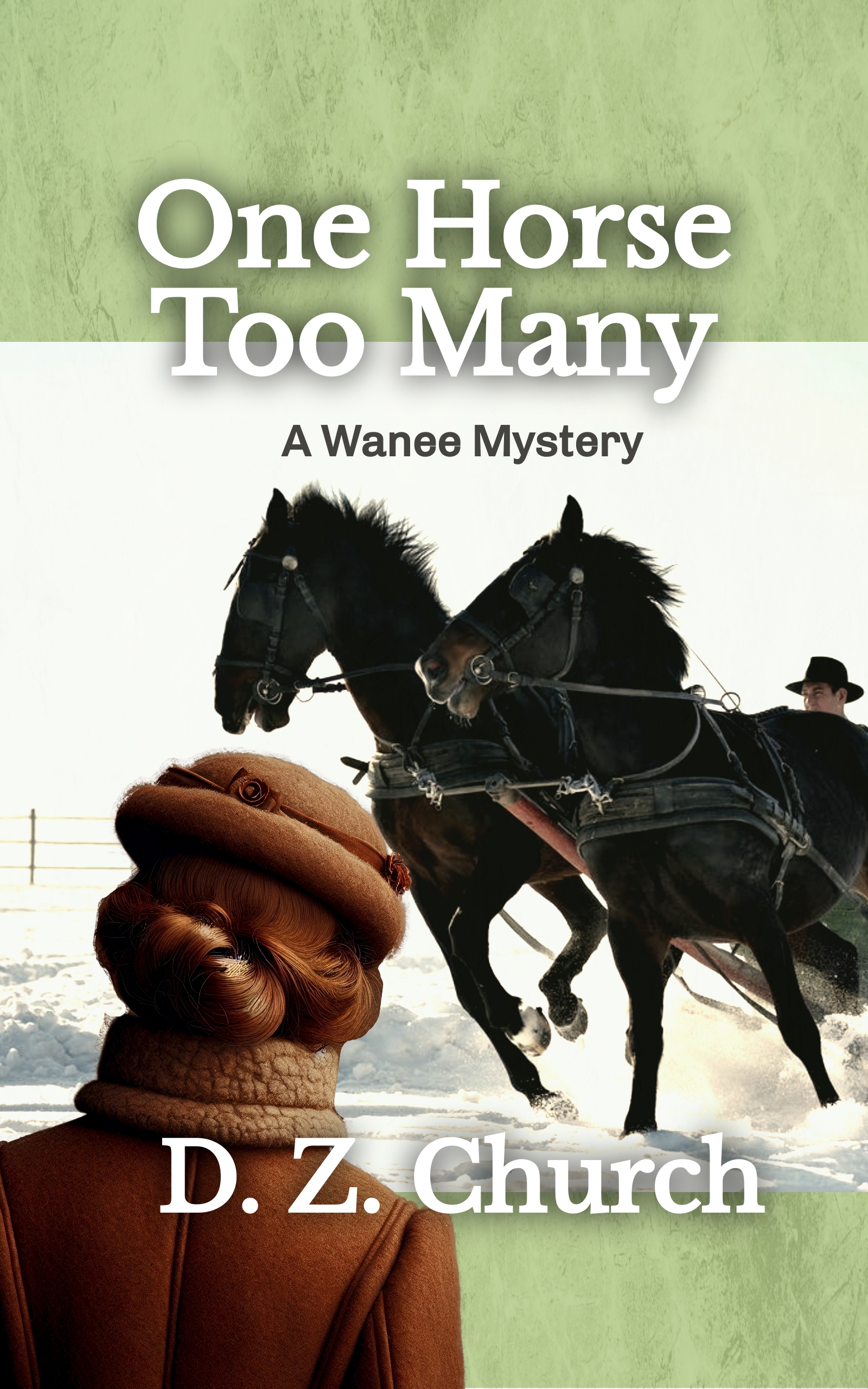
  3. Or this: A team of four horses hauling a freightwagon at a gallop in a blizzard. What I asked for in the world of AI is a galloping freight wagon hauled by a team of horses hauling four horses in a blizzard. (abandoned – see picture)
  4. Or this: A freight wagon with a broken wheel behind a team of four horses tipped over in an icy snowy stream. What I got, and rightly so, was tipped over horses under a freight wagon in an icy stream. Too gruesome to share. (abandoned)
  5. Close, but no cigar. Learning, I requested:  A 1870s brown-haired, clean-shaven man in a derby hat on a horse with a doctor’s bag in a snowstorm. A wonderful illustration came up. The man even had a distressed look on his face, which was perfect. I thought I had a live one until I realized the doctor’s bag was sitting unattached at the back of the horse.
  6. So, here is the evolution of prompts that led to two illustrations that met my needs. This isn’t to say there weren’t others that were good, just not right. Notice the order and precision of the description that resulted in my final choices (** indicates the two I kept for possible use).
    • An 1870s man reaching for black cowboy hat floating in nearly dry stream
    • An 1870s man in a white shirt reaching for black cowboy hat floating in nearly dry stream (picture 1 **).
    • An 1870s man in a white shirt reaching for black cowboy hat stuck in bushes on the banks of a stream
    • An 1870s man in a white shirt pulling a black cowboy hat from bushes on the banks of a stream (picture 2). Note weird dent in the crown of the hat.
    • A 1870s man in his twenties wearing a cowboy hat and a white shirt with his sleeves rolled up retrieving a Stetson caught in the brush along a slow flowing stream. Serious beefcake. Also, there is no hat on his head, and I’m not sure what he is retrieving. But he sure is pretty! (picture 3)
    • A 1870s man in his twenties wearing a white shirt with rolled up sleeves retrieving a Stetson by the brim caught in the brush along a slow flowing stream (picture 4 **).

Summary

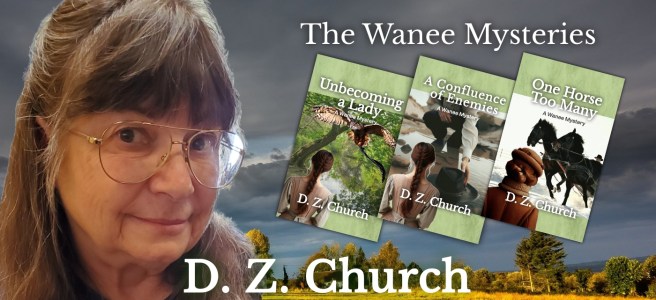
In the final analysis, I was pleased with the results and glad I had chosen an ethical AI service for my plunge. As my character Cora Countryman (Unbecoming a Lady, A Confluence of Enemies, and the upcoming One Horse Too Many) would say, I do not truck with pirating the work of authors and illustrators without their knowledge or reward.

Find my books at https://dzchurch.com or on Amazon.

Coloring in Characters

I woke up in a cold sweat, dreaming that all the main male characters in my books were raven-haired and blue-eyed. Why raven hair; why blue-blue eyes? With a toss in bed, I divined that it was because my eyes are like cesspools. I envied every blue-eyed person I saw. I even married one. Reassured, I went back to sleep.

A few hours later, a vision of Grieg Washburn, from Saving Calypso, all five foot eleven, dark brown hair and blue eyes of him made me sit straight up in bed. I began inventorying .

Perfidia, one café au lait with brown hair and gray eyes and another with brown hair and deep blue eyes, so blue they appear black. Booth Island. Dark hair, dark eyes. “Beneath the black horn-rims, his eyes, noir, schwarz, beltza, svart, black in any language, absorbed the light in the room.” Glasses, too. Two wins.

The Cooper brothers of the Cooper Quartet, one tall, dark and blue-eyed, one red-headed with amber eyes. 50/50.

Doc and Kanady in the Wanee Mysteries, one with brown hair and gentle, soft brown eyes, the other with hair “the color of a shrew’s back” and sharp blue eyes. 50/50.

So, what was the crazy dream all about? Invention of character, I suspect.

As writers plot, we envision the emotional and physical strength the protagonists and antagonists will need. Should they stand out in a crowd or disappear? Does self-loathing or self-love color their world. Who are they ethnically, from where do they hale, what made them them? We see them in living color, dark, light, shadowed and paint them through their actions, other characters’ perceptions, or self-observation. To me, a character’s hair, eyes, complexion are tells that create an image and a touchstone for the reader, leaving the reader with a bias for the good or bad.

And off we go with a spot of good guy, bad guy:

Booth Island. Sturdevant’s eyes roved over my shirt and down my shorts to my sandals. Meanwhile, I studied the jagged scar over his left eye that continued into his hairline. It was new since he was cuffed and taken into custody, as were the glasses he now wore. Horn-rims. The left lens was as thick as my little finger. His black hair was shorn short on the sides, unmasking a thickly scarred depression above his left ear. Dark stubble stained his strong jawline and accented the hard lines of his mouth.   Good guy   ☐ Bad guy   ☐ Both

Saving Calypso. Rafe was tall, broad-shouldered and powerful from living off the grid or perhaps from his years in the U.S. Army. He had a generous nose, an engaging mouth, sweet blue eyes, and a square chin. He wore his dusty blond hair in a thick braid, uncut since he had hiked into the mountains.  ☐ Good guy  ☐ Bad guy  ☐ Both

Perfidia. He not only smelled male; he smelled like money, lots of it, as though he had been rubbed in it since childhood. His too-close-together eyes were a deep, dark blue with black corona. His umber hair would have been in ringlets if not for the expensive, stylish cut that left it long in the back and waving over his ears.  ☐ Good guy   ☐ Bad guy  ☐ Both

Dead Legend. Mike Bowen hadn’t changed in the twelve years since Byron had last seen him, still stocky, his sandy blond hair still in a butch. He had one of those faces that had battled its way through school. His nose had a slight drift to the left. He had a scar through the blond of his right eyebrow.  ☐ Good guy   ☐ Bad guy  ☐ Both

A Confluence of Enemies. Thime hunkered down on his wagon and offered his right hand, palm up, for the shake. A welted scar disfigured the soft side of his right forearm. Mr. Kanady glanced at it, his shoulders squared, his head bobbed back until he stared into Thime’s blue eyes. At that moment, Cora noted, the two men might pass for brothers. Except Thime was years older and inches shorter. It was their shared coloring and a certain sharpness in their eyes. ☐ Good guy   ☐ Bad guy  ☐ Both

For more on visit my website dzchurch.com where you can order a book, sign up for my newsletter, and learn more about each book.

We All Have One

You know what I mean, the one review that just sits in your brain and ferments. It doesn’t even have to be a negative review. In fact, there is almost always a grain of growth in the bad ones, that comment that helps one become a better writer or calls attention to a technique you use that can be annoying. That sort of thing.

Mine is a recommendation, no less. But talk about damning with faint praise. OMG. Yet, that’s not what bothers me about it — well, yes, it is, in part. It seems to me that if you are recommending a read, you might emphasize the good parts, you know, the stuff you liked.

I get that some people think all critiques (reviews) are critical; after all, the word alone conjures criticism. Right! But according to the dictionary people, review means a critical appraisal of a book, play, movie, exhibition, etc., published in a newspaper or magazine or on any number of websites. There is that word critical, again. Interestingly enough, the example is: “She released her debut solo album to rave reviews.”

So, Back To My One

It makes me crazy. Remember, it is a recommendation. Though the reader finds my protagonist silly, it is the rest of the sentence that makes me gnash my teeth, stutter, and obsess. Why? Because of the presumption of it. I tell myself it is okay, because the reviewer didn’t know to make the week in week’s laundry possessive. But it is not. It is because the individual presumed I know nothing about the time and energy required to do a week’s worth of laundry, baking or housecleaning!

I guess I am so very rich from my writing that I have a domestic doing my housework. Not! Here’s the issue: I have used a washing machine with a mangle on it and, yes, gotten wrung. I’ve risen as the sun tinged the horizon to do chores including; feeding chickens, gathering eggs, feeding pigs and hogs, and bringing milk cows in from the pasture. I have hung laundry on a line, ironed sheets, helped bake bread for a week, and cleaned a house from top to bottom. I do know the time and labor it takes.

Why Can’t I Let It Go?

Because it is so unfair. And unmerited. And because of this (from Unbecoming a Lady):

Drawing heated water from the boiler on the stove, she scrubbed using the washboard and her mother’s technique: swipe the bar soap over the item, dip, soap again, scrub, dip, soap, scrub, rinse. Red blotches rose on her hands from the harsh soap and hot water.

When the wicker basket was full of wet, washed clothes, Cora ran the sopping items through a hand-cranked mangle, a nasty piece of business with two rollers to wring the clothes. A barrel positioned under the mangle captured the rinse water from the flattened, wrung-out clothes. Cora would dilute it with some fresh and use it to water the garden.

Her back and arms ached by the time she had the week’s laundry hung out to dry on lines strung from a crossbar nailed to the base of the windmill to a pole with a crossbar fifteen feet away. Cora rested her red, scaly hands on her hips, watching as a soft, warm breeze ruffled the items on the line, swaying them into a kaleidoscope of color, and dreamed of a washing machine like the one advertised in a Chicago Tribune she had thumbed through while waiting for the cashier to total her purchases and debt at Blewett’s Green Grocers on Chestnut Street.

You Decide

Did the reviewer read the book? Don’t you just wonder sometimes? But we learn something from all our reviews; from this one, I learned when writing a review, don’t presume you know anything at all about the background of the author of a book. Just don’t.

visit my website dzchurch.com for more information about all of my books.

Audiobooks, AI and Me

I am participating in a Beta test using AI voices to generate audiobooks. Interesting. And not altogether a bad experience, but a time-consuming one. Most audiobooks run about 20-26 hours, so there you go. But if it works, it makes the creation of audiobooks available to authors without the loss of an arm and/or a leg.

So, things I’m learning.

Choosing a Voice

Listen to all the voice options: male, female, American or British, then pick the narrator your reader would expect. Right now, the options are limited. I chose a twenty-something female for one book and a late-twenties-sounding male for another.

A real plus is that you can change narrators mid-stream without losing your edits.

Don’t watch the screen — Listen

The AI I’m trying out has a marker on the screen that moves from word to word with the narration. If you watch the screen while listening, the paced rhythm of the marker takes all meaning out of the sentence – dah dah dah dah. So shut your eyes and listen for the modulation in each phrase and where inflection changes the intended meaning of a sentence.

As you listen to the very human voice, it is easy to forget it is machine-produced. Yet, it can’t interpret the narrative like a voice actor or a reader would. So, you will need to intercede. Currently, choices are limited: speed a word up, slow it down, or add long or short pauses. Speeding up and slowing down words can affect modulation in unexpected ways, requiring several passes to get the inflection just right. It would be nice to be able to modulate the timbre of the voice for those occasions when a question needs to end other than on an upbeat, but it is not available.

Adding long and short pauses is critical to pacing and understanding. For instance, rapid banter, easily understood on the printed page, needs pauses between speakers to assist the listener. Without a pause, the exchanged dialog becomes a jumble, losing its spice as the listener struggles to figure out who said what to whom.

Listen to each word — Carefully.

The voice replicates standard English; is there such a thing? So, homophones are an issue. For instance, bow (beau) consistently being pronounced bow (as in bowed before the king) no matter the context. And the verb does pronounced as though it were more than one female deer.

The pronunciation pop-up doesn’t translate diacritical markings, which means you have to find a set of letters that creates the correct sound. For instance, duz gets you does and avoids a herd of deer roaming your book. The good news is you can apply pronunciation changes to all instances of the word in the text. The bad news, well, read on.

Users are warned to listen to the complete book before accepting the audiobook conversion; heed it. Else, this could happen. Crappie fish may be croppy to you and me, but not to the AI voice who happily asserted that crappy fish swam in a pond. And in what makes no sense, the voice insists that bass is pronounced base, as in bass violin, and will not say bass, as in fish. And the letters bass, which should produce the correct sound by all rules of the English language, don’t. Nor do b ass, baz, or bahz or, well, anything. English is a minefield of weirdness. But as it turns out, the AI voice is very good with French, thus beau.

Then there are em dashes? Well, imagine my surprise when the voice opined: yes, dash, she changed. Using the pronunciation feature, I tried substituting a fast uh, but that—uh — isn’t always appropriate. So, what do you do? Sometimes, I add a word to make a stutter. Sometimes, I fill in the blank with the missing word(s). It is a conundrum. If the dash is set off with spaces, the voice says dash and if it isn’t, it runs the wordstogether.

What I’ve learned — Mostly

Listen. Listen twice. Learn your options for editing, fast, slow, and pauses and how they affect pace and modulation. Watch out for homophones, some are truly unexpected – as the female deer attest. Watch also for possessives, as the voice tends to hesitate for apostrophes, Eliza s, and needs to be overridden. Watch foreign names and words, unless in French. Be chary with em-dashes, though this issue should be addressed by the programmers. For instance, the voice doesn’t have a problem with ellipses. I know. Weird, huh?

And finally, if you find errors in your manuscript while creating the audiobook, don’t be afraid to correct them. The AI I am tinkering with automatically updates the audio text along with the manuscript text. Not bad, that.

See all my books at dzchurch.com where you can also sign up for my newsletter.