Gut Check Endings

It’s that time of year when we all do a gut check on our writing and output. Well, my guts all like wombaldy-peg (something my mother used to say among many other sayings she had that made no sense – ever – but were highly descriptive).

I had a goal for book sales. I don’t think I’ll make it, but it will be disgustingly close. Just off—a wee. My gut doesn’t like that. I’m not the: well, maybe next year sort of lady. Now – please.

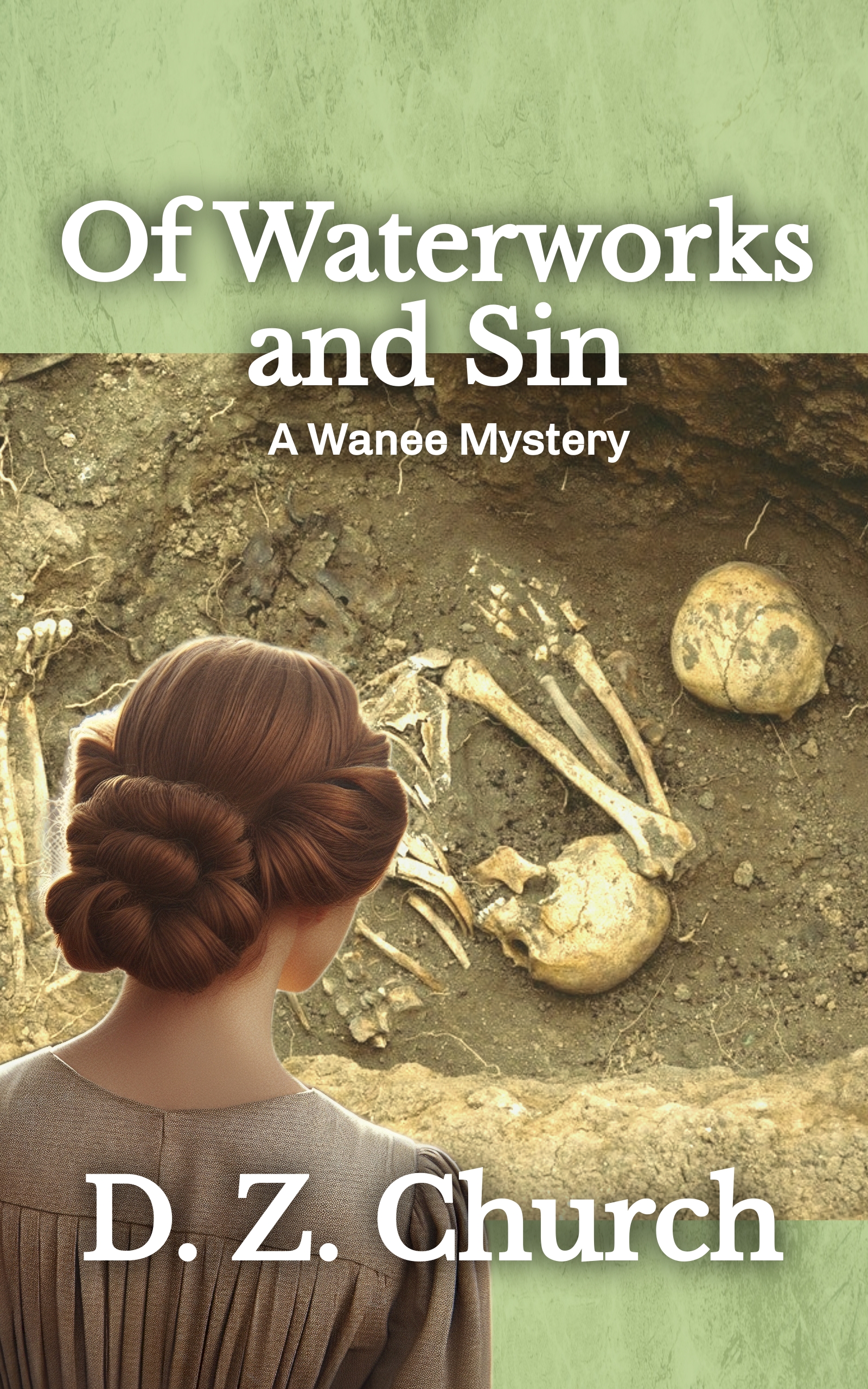
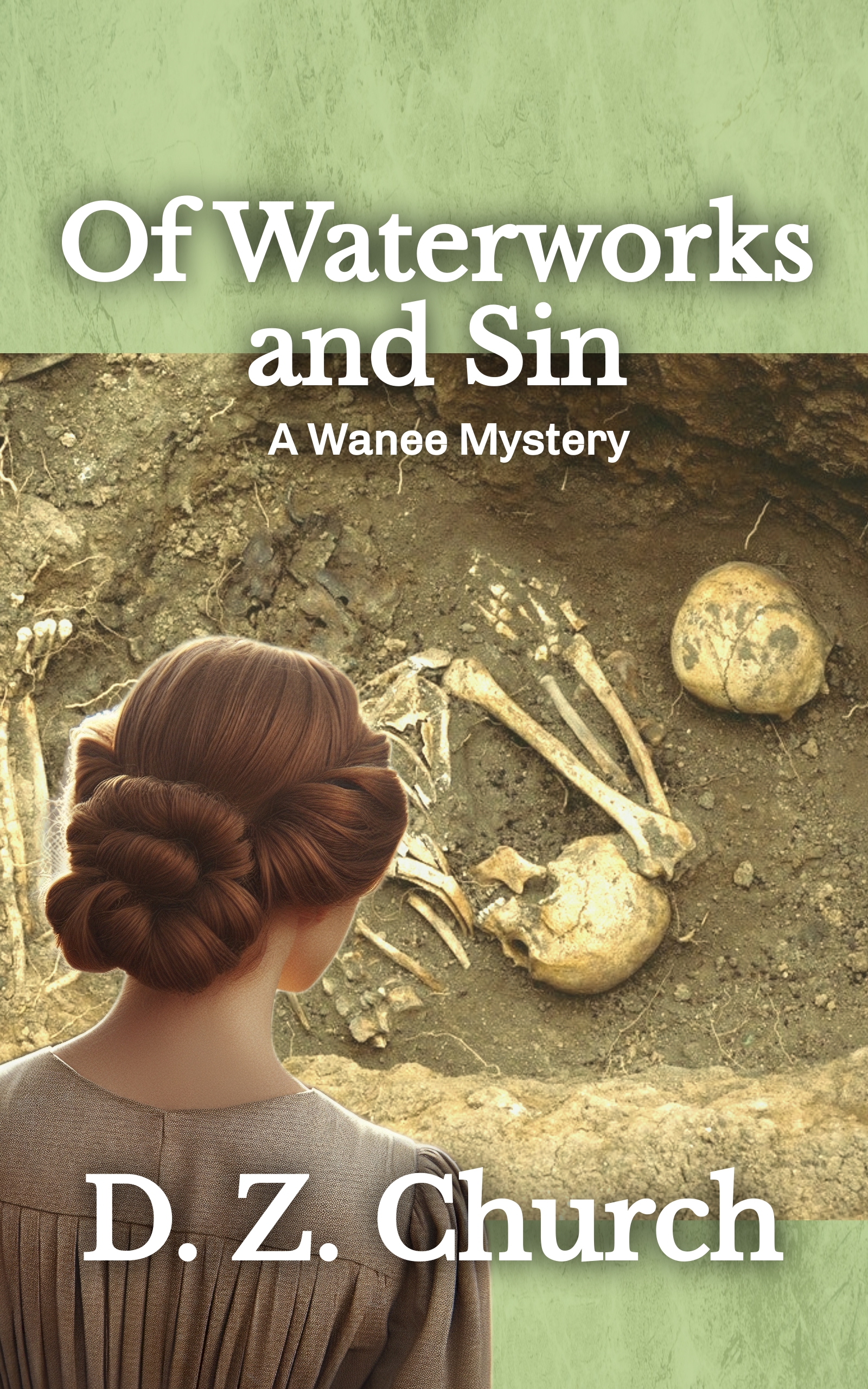
Faced with a gut rumble, I rewrote the ending of the latest Cora Countryman book, Of Waterworks and Sin, and sent it out to my beta folks weeks after the text.  Second guessing is my problem, well, no, endings are my problem. I think I’ve rewritten every one of the endings to all four Cora books at near the last minute (as Cora would say). My gut tells me that’s not professional, my brain isn’t listening. It says it is more important to get it right than to worry about the timing of getting it done. Okay, I can live with that. Maybe. Just.

The thing is this. If the last sentence of a book in a series isn’t gut-checked and perfect, where do you start the next book? Well, I’m sure the writers with their wallboards, index cards or Scrivener have it all charted out. Me, not so much. I need to leave myself clues like Hansel and Gretel did breadcrumbs.

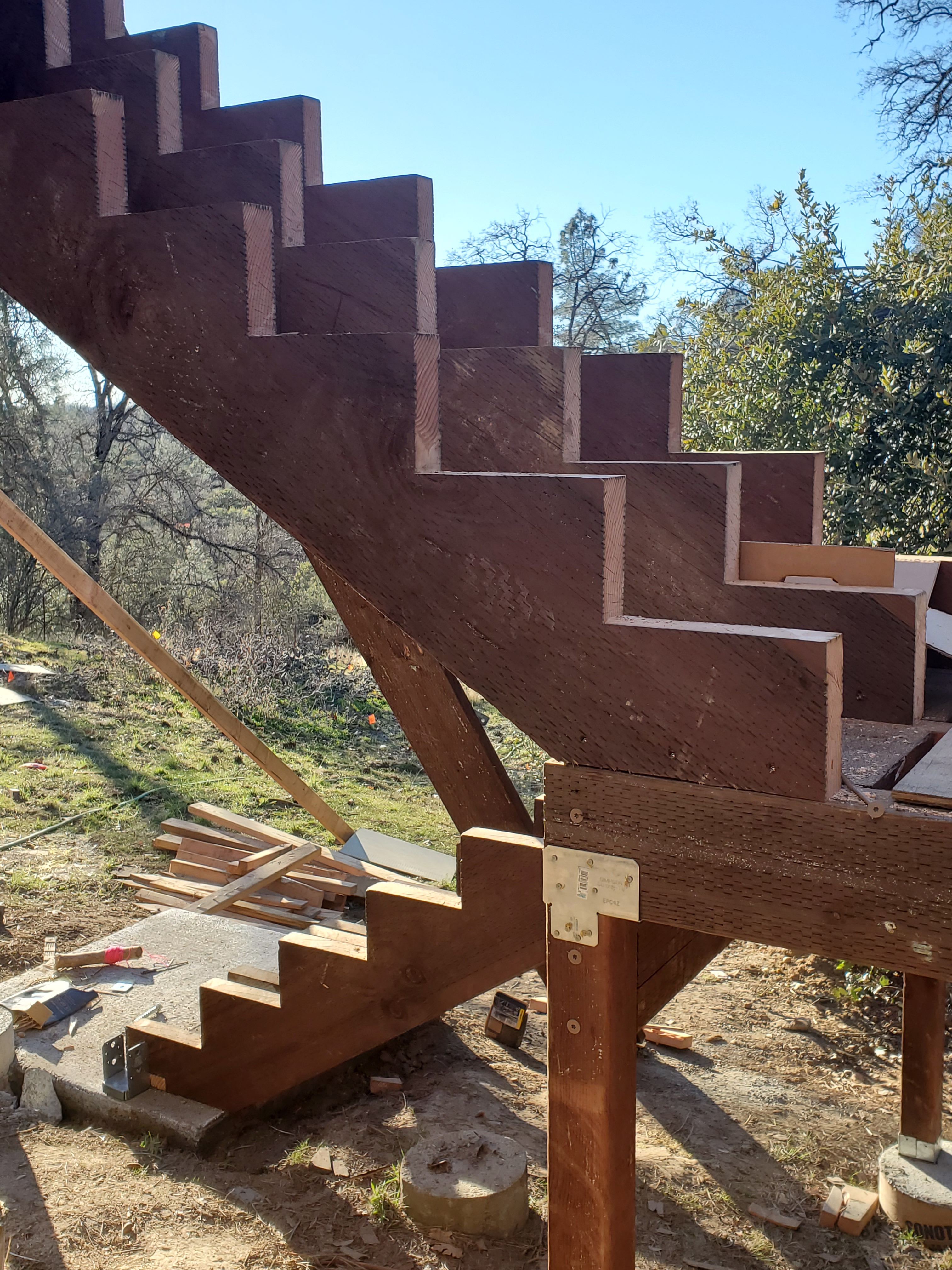
I’ve been staring at the beginning of Cora’s next book, the fifth in the series, for what seems like weeks. Partially because I have a cabin in the mountains and my fire insurance was pulled. I thought I had it until the insurance company’s threats arrived, and I found myself wrangling contractors to get upgrades made so I could overpay for fire insurance when my place is a mile from a park service fire training station. It occupies your mind, not to mention the thumping and bumping on the walls as your deck is destroyed and your siding comes down.

Still, I had a good start on No-Name Book 5 until I realized I needed to explain how Cora came to be on a riverboat on the Mississippi. When I put the backstory in, it was like blah, blah, blah — blah. Why was the blah-blah needed? I stewed about it, especially at 4:00 am just after I got through tallying my finances for all the fixes required by the insurance company. The gut came to the same conclusion every time. The ending to Of Waterworks and Sin wasn’t doing its job. Cute, fun, and dangly, but totally responsible for the fix I was in with the No-Name Book 5.

Thus, the new ending Of Waterworks and Sin sent to the beta folks. Now, No-Name Book 5 is off and running; the plot unfolding before me, not exactly the one I have diligently outlined. It never is. That gut again. But a great plot, action, romance, mystery and redemption all while floating the characters down the Mississippi and through history.

My head tells me I need to do more period research. My gut says hit it at a gallop and fix it later. If that sounds like Nora Roberts, so be it. Sometimes you just need to quit with the research and go. That’s what resource books and the internet were bred for – checking and double-checking facts as you write.

I have a fledgling plot for book 6 (I can’t wait to write it). I hope with insurance coverage and a restored cabin.  If my gut tells me the ending of No-Name Book 5 is off, I’ll listen. This time before it goes out for review. That way, I can avoid a visit from the Pooeyanna Bedhunters (another mother-ism – don’t ask) and have a happy gut. Who knows, maybe next year I’ll make my goal.

Don’t forget to check out The Ladies of Mystery Cavalcade of Books at https://bodiebluebooks.com/ladiesofmystery. The prices listed are good through December 31st. The mysteries offered inside are great anytime.

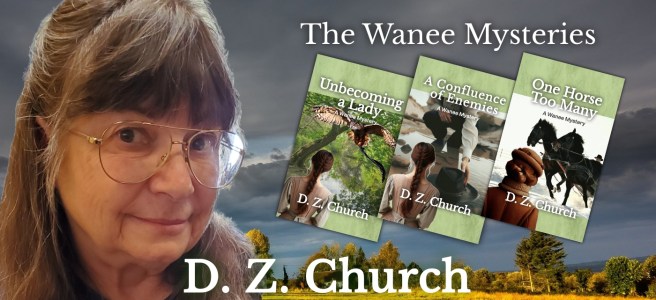
Find more about me or sign up for my newsletter and https://dzchurch.com. And watch for Of Waterworks and Sin sometime in Spring 2025, the date depends on my reviewers, don’t you know?

The Snake in the Grass

The leaves on the oak outside my window have yellowed and are heavy with rain. Wonderful rain. No more threat of fire, though we do seem to have a wee firebug in our area happily lighting small blazes that keep our CalFire folks busy. No need to ask why. Power is almost always the answer.

The desire for it, the need for it, and the loss of it. As strong a motive for murder or mayhem as any. Perhaps greater than jealousy, love, and hate all combined. But not money because money is part of the power paradigm, a weapon that can be unleashed against others to keep them at heel.

The scariest purveyors of power are those in sheep’s clothing. As I write that, I am thinking of Rev. Francis Davey, Vicar of Altarnun, in Daphne DuMaurier’s Jamaica Inn. As foul a human as one could imagine, one who envisions himself as a wolf in front of his unsuspecting flock of sheep. A villain’s shuddery villain, without a name until the reveal, the puppet master. Oh, there are others, but this was my first and yes, a chill ran up my spine when Mary Yellen found the Vicar’s drawing.

Power. Control. The conceit of holding it close, knowing you alone are aware of the power you wield. Oh my. But how to write such a character, so subtle, so hidden, yet the master of your story? There are types. The helper, the one who is always there, gently steering the protagonists toward doom. The gay, happy, rich, swoon-worthy antagonist who attracts the innocent and then uses them. The antagonist, so subtle so in need of winning, that they move through the plot like a water moccasin through a swollen river.

These aren’t the people you are consciously watching as you read; they are the ones that niggle at the corners of your mind. Why was he in the room? Why did so and so seek out our hero? Why are they everywhere? What is their purpose in the tale? They couldn’t have been the killer. Or could they, or is something more nefarious their goal? Like their purpose in the book, they bring power and control to the narrative. A drive that bubbles below the surface until it boils.

I love ‘em, I do. And I admit to weaving them into the occasional book. The purposeful manipulators. The ones with so much to lose that they are blinded by the need. The ones who will do anything to win. Lie, cheat, steal, kill – take over the world.

Books are rife with the bombastic variety, but it is the snake in the grass I love. They are a shoot of wheat rattling in a nonexistent breeze that catches your eye and sends a frisson up your back.

I know this as a writer.  It takes great discipline and tedious planning to develop such a character, keeping the behavior consistent and weaving the foreshadowing to sustain the mystery. Because the one thing readers will never forgive you for is throwing in a surprise killer or manipulator. If you’ve done well, the reader will relish rewinding the book for clues that implicate the character. If you’ve done it wrong, they’ll close the book and perhaps never read a book of yours again. And that, my friend, is a scary proposition.

A friendly reminder, The Ladies of Mystery, Cavalcade of Books is available at https://bodiebluebooks.com/ladiesofmystery. It’s filled with wonderful tales, some with well-hidden evil. Twenty-nine great reads, including three of mine.

Find me at https://dzchurch.com and on Amazon, just search on d. z. church.

The Company You Keep

Those of us of a certain age were often reminded while growing up, wearing skirts to school, and forced into home economics classes that our reputation was favorably or unfavorably based on the company we kept. If that is the case, then I am one lucky lady.

Recently, I embarked on a project for Ladies of Mystery … its first-ever catalog. The Ladies of Mystery Cavalcade of Books will be online from November 15 to December 31 and feature hand selected offerings from all ten of the Ladies of Mystery bloggers. But that’s not the point. Well, it is, sort of …

In gathering the information for the catalog, I discovered how truly talented the Ladies are. Boy, am I in good company! Did you know there is a Lady in Nova Scotia, one in Texas, and our Lead Lady lives in Oregon? The Ladies live in big cities, in the mountains, and on alfalfa farms. They write about animals, runners, Native Americans, women sleuths, private investigators, families of investigators, small towns, historical fiction and mysteries, romantic suspense and cozies. The gamut of mystery writing – well, not hardcore or noir, but a few that brush the edge.

In her introduction to the Cavalcade, Paty Jager, Lead Lady, writes that she founded the site “to bring mystery writers and readers together to learn about new authors and to get an idea of what it is like to write a mystery book.”

And what a group she lassoed– award winners to newcomers. Am I humbled, yes. Writers tend to be a solitary lot, well, at least, in my case. Yes, we meet at conferences and share our victories and conundrums with each other. Sometimes we do this during online calls, in small groups. We read each other’s books to support our fellow authors, leave reviews, and sharpen our skills.

But, in the end, we sit in a room, at a computer or a typewriter and write, poking our heads out of our holes to take care of the mundanities of life, like bills, food, husbands, cat and dogs, and children.  Not necessarily in that order. Sometimes, we just stare into space or tap our toes at the breakfast table, our brains on the single-minded railroad pulling into Plot-town.

There is always a challenge. Are the clues just so? Are the characters behaving as they should? Are they true to themselves, or have they taken off on some wild bent, dragging the plot behind them like a used tissue? It happens.

So, it was while mulling a rather horrifying historical error in a book I was writing that the idea for the Cavalcade of Books was born. Because, sometimes, the only way out of a hole as deep as the one I dug myself is to redirect your creative energies. Now, I admit, I had no idea how much fun the project would be. And I thank all the other Ladies for their advice, help, and wonderful books chosen for the first-ever Cavalcade of Books.

When the Ladies of Mystery Cavalcade of Books goes live on November 15, you’ll find a bit about each Lady, followed by books categorized by genre. I admit to having fun naming the categories, with able help from another Lady whose fantasy helped me break loose from the humdrum genres. The categories are:

  • The Ladies Save the Day – Mysteries featuring a woman or amateur sleuth
  • Past Perfect (Way back when) – Historical, psychic and ghost-filled mysteries.
  • Cozy by the Fire – For lovers of cozy mysteries
  • Thrills, Chills & Skills – Detectives, private investigators, people caught in webs of lies, deceit and thrills.
  • Made for Each Other (Romance and Mystery) – romantic suspense
  • Written Communications – advice on communications resides here.

The Ladies of Mystery Cavalcade of Books is the perfect opportunity to discover a new favorite author, or new genre, or a new book by an old favorite. As I did. And they are gems.

In the meantime, if you haven’t checked out all the Ladies’ blogs, you should. Talent, diversity, and wonderful tales await you. Like they did me.

Find me at https://dzchurch.com or on Amazon

Me, a Tree, and a Cat Named Blue

Have you ever had one of those days when writing anything much less a mystery is beyond your ken?

That’s me. My inner workings are consumed by the loss of a massive, centuries old pine tree and my cat Blue’s determination to regain cat-dom.

A month ago, Blue had a stroke and went all bobble headed. He could not stand up, much less walk. I had to feed him at intervals throughout the day and night, holding his bowl so that he could eat. But he ate. Not enough, still … that was then, and this is now. I bought him a bowl that required him to stand up to eat hoping to get him on his feet. He stood. He eats like a pig, snuffling as he snarfs. I took him out each day, steading his body between my legs then, with my hands, showed him where his front feet went, hoping his back legs would follow. They did. I urged him to keep his head up as he walked. He does. Now.

He’s sixteen years old. A glorious, big Russian Blue and he has the heart of twelve others. Today was a big day, I moved the donut where he resides away from his food bowl and litter. The plan being he would have to walk and exercise his balance. His first outing to his food dish went well, though he had a hard time finding his way back to his newly moved donut. Still, he did.

After the stroke, I thought we would have to let him go. I thought wrong. He is a gamer. Sometimes, I wonder about his memory. He doesn’t seem to recognize his name. Hard to tell with a cat though. My husband and I kid about renaming him Roomba because he always returns to his donut. Still, he’s with us and progressing. I don’t think he will ever be the cat named Do-Do, left at the SPCA at a year-old, unadopted for two years until he saw my husband and wouldn’t let him go. Boys!

Speaking of whom, husband that is. He spent a full year trying to save the 112-foot Jack pine that dominated the view out our back slider. The wind blew in the pine bore beetles. The tree took the first onslaught and shook it off. Then a second wave hit it. The top died, though the lower branches clung to life. An arborist recommended fertilizer, my husband fertilized, watered, babied, talked to, prayed for, and fought for that tree. When Pacific Gas and Electric wanted to cut it down, claiming it could fall on wires over sixty feet away and uphill, he stood his ground. In the end, we negotiated with them to top it. They took 32-feet off it, and it still clung to its needles, sheltering crows, squirrels, woodpeckers, and even vultures.

Today it is gone, a skeleton lying down our hillside so far that the woodcutters had to take twelve feet off the top to pull its brittle bones onto our property. They can’t cut it up right now because the rest of their team and the truck they need are working a fire burning in the High Sierra. Meaning, until the National Fire Service releases the team from duty, we have the shattered remains of a once mighty tree to mourn.

About now you’re asking yourself, what does any of this have to do with reading or writing mysteries. This, I am struggling with the fifth book in my Wanee series. And all I can think of is them, a cat named Blue, and tree named Frank. Yes, Frank. And my husband.

Two fought to the end to overcome the ravages of climate change, the other perseveres, step by step, falls, then gets back up and takes another step. So, get with it, girl, word by word, sentence by sentence, paragraph by paragraph, you will have a book. It is so hard, it’s easy.

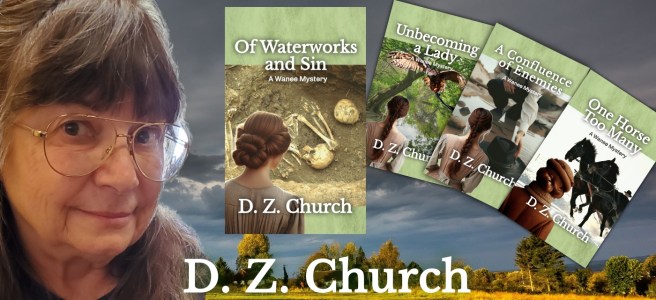
One Horse Too Many, the third book in the Wanee Mysteries is now available. According to a couple of other Ladies of Mystery it is a “really strong entry into the series” and “another winner in a great series.”

For more information, to sign up for my newsletter, or buy a book, go to https://dzchurch.com.

The QWERTY of It All

From the Milton-Howard collection.

The QWERTY keyboard? Who in the right mind would organize letters that way? And yet, we all use it. Our fingers know exactly where to find the letters. Well, mostly. If you’re like me and your right index finger occasionally misses the tiny dimple on the j, a trip to Bletchley Hall may be required to decode your deathless prose. So, who put the A there and the M where it is?

In my newest book, One Horse Too Many, Cora’s boarders are gathered for dinner in Countryman House’s dining room where Dr. Shaw speaks of the Centennial Exposition of 1876, where the QWERTY type-writer, the Bell telephone, and giant boilers able to heat whole buildings were introduced. Yet, while people traveled to Philadelphia to see the wonders, General Custer fatefully met the Sioux in Montana, and the James-Dalton Gang robbed the Northfield Minnesota bank. The years 1876-77 were like that, colored by the past and roaring toward the future.

Telegraph operators tapped out the news of the massacre and the robbery on QWERTY keyboards. So, how did the board’s odd array of letters come to be? In October 1867, Christopher Latham Sholes, a newspaper editor and printer who lived in KenoshaWisconsin, filed a patent application for an early writing machine developed with the assistance of two friends (Glidden and Soulé). 

Sholes worked five more years to perfect his invention, rearranging the alphabetical keys, until 1873, when the QWERTY keyboard came to be. If you spend some time with your keyboard, you will notice that the letters are arranged in diagonally slanting columns. This was done purportedly to accommodate the mechanical linkages, as slanted columns prevented the levers from tangling. Yes, you pushed on a key, and a lever slammed the letter onto a ribbon of ink, leaving an imprint on your actual paper.

Now, researchers into the evolution of the keyboard conclude that the typewriter’s mechanics did not influence keyboard design. Instead, QWERTY resulted from how and by whom typewriters were first used – namely, telegraph operators, whose need to quickly transcribe messages informed the letter arrangement. Also, some cite educator Amos Densmore’s study of bigram (letter-pair) frequency as influential in the design.

In 1873, Sholes & Glidden sold the manufacturing rights to their Type-Writer to E. Remington and Sons. Remington made several adjustments after purchase that resulted in the modern QWERTY layout. These adjustments included moving the R key to the place previously allotted to the period key. With the new arrangement, the last vestiges of the actual alphabet appeared only in the home row sequence DFGHJKL. It makes you want to kiss them, doesn’t it?

And how about this nugget? The QWERTY arrangement allows thousands of English words to be spelled with only the left hand but only a couple hundred with the right hand, even though using alternating hands with the first hand striking as the second readies aids speed and accuracy. Does that make any sense?

Well, this makes sense – business sense. In addition to typewriters, Remington offered training courses (for a small fee), ensuring typists learned on their proprietary system. This forced companies that hired trained typists to buy Remington typewriters. By 1890, more than 100,000 QWERTY-based Remington typewriters were in use nationwide.

When the five largest typewriter manufacturers merged in 1893 to form the Union Typewriter Company, they agreed to adopt QWERTY as the de facto standard, and it still is. Though there have been attempts to make an easier to use keyboard, the QWERTY board is so prevalent that the cost to make a worldwide change is prohibitive.

And really, why change something that has produced so many enjoyable books, like One Horse Too Many, available September 15 (pre-order starting September 1)? Here’s a teaser: Sales are up at Cora’s dress shop, and she is making headway on her debt. Her new cook scares everyone and her domestic is a mess. Things have just settled when much-needed drugs are stolen from the hospital, and the newspaper office is tossed. If you like a rip-snorting yarn and appealing, strong-willed characters, you’ll get a kick out of this old-fashioned mystery.

Check out my books at https://dzchurch.com.