The Magic of Families

From the first Thanksgiving to this…there is magic in our past, and in families who share their stories across that long linen-covered table filled with the food of our nation. As Americans, we often mourn the loss of the nuclear family, but that loss is as old as this country. Those who came first left the safety of a more settled world for the new. And boom! (That’s my version of a nuclear explosion.) They didn’t all stay put; some moved, east to west century after century, connecting, shifting and moving on.

The magic that links us is in the details.

My husband’s family (both sides) came to America shortly after the Mayflower landed. You can call them early adopters, or people seeking religious freedom, either works. Though one group was from the Netherlands and the other from Great Britain, they both left the Netherlands for Massachusetts on the same boat. I have visions of them, one group in their wooden shoes and pointy white hats, the other in their black-and-white Puritan best, huddled in steerage, having a golly-really conversation about Puritanism. Neither group took to it. Those from England stayed in the Bay Colonies before heading south to Rhode Island, then to New Jersey, and finally to Pennsylvania.

The Nederlanders migrated to what became Johnson County, Indiana, where they farmed and became Presbyterians, producing many ministers. Then, almost three hundred years later, the offspring of these immigrants met in Syria, one as a missionary, the other teaching, and, well. Think of the time they could have saved if the two families had married into each other on the way to the Massachusetts Bay Colony.

More magic

My father’s mother’s family were Cumberland gappers and verified DARers (yes, they’re in the book). The Alsace-Lorrainian farmers on the other side arrived in the 1830s. Reports handed down through the family drum, which has proven quite accurate, and, with a family bible as evidence, claim that one of those pesky people who keep marrying into families (you know the sort) also hung out in Johnson County, Indiana and married into my father’s line.

If the evidentiary bible is correct, that family sported a Low Countries surname, not dissimilar to that of my husband’s mother’s family.

So, did my husband’s relatives and mine coffee clatch back in Johnson County before each packed up and moved further west? My family to Illinois (is that really west?), my husband’s to Oregon, back when, though a state, it was pretty frontier-ish.

Ruminate on this: How do two people, one from Oregon and one from Pennsylvania, whose families shared passage on the same boat to the New World in the 1600s, end up in Syria about a day after Lawrence of Arabia left and marry each other? And how does their offspring end up marrying a woman in California whose family roosted in Johnson County, Indiana, in the 1800s, when one was born on the East Coast and the other in Illinois?

Gabble away over your turkey

You might discover connections to your past that lead to a future. I urge you to remember, as you write your next tale, nothing is too weird or coincidental when it comes to a family’s past (translation: the duck might be somebody’s uncle).

Happy Thanksgiving. Lots of Turkey. And hugs to all.

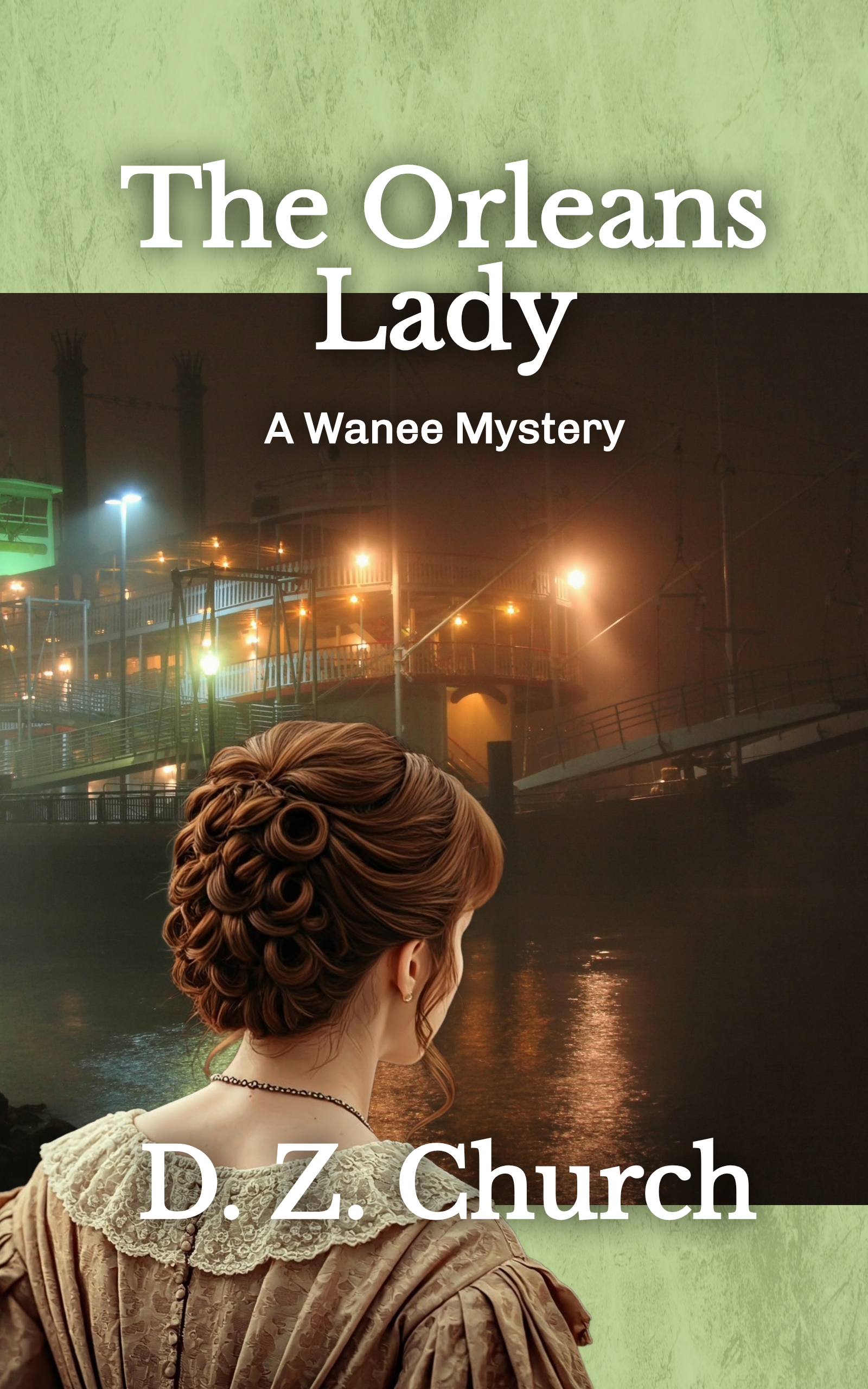
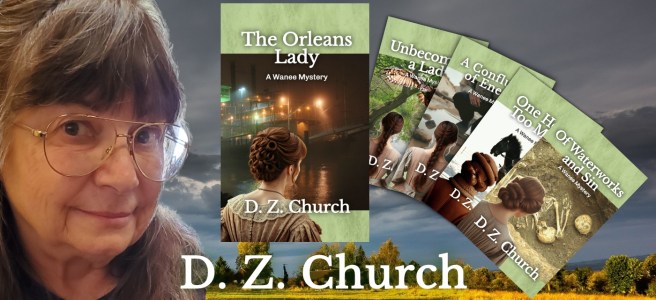
Update: For those of you who worried about my lost file. I found it!!!!!! And restored it!!!!! And the book, ‘The Orleans Lady’, is being beta-read right now!!!!

For more about me and my books, go to https://dzchurch.com, where you can sign up for my newsletter and find juicy facts about all my books, including The Wanee Mysteries and The Cooper Quartet. You might even find yourself clicking through to buy one or two, or, heck, all.

The Irrational Terror of it All or Losing the File

I lost a file.

I’m of course not talking about any file. I’m talking about the file, the one where you’ve gotten the last draft almost exactly where you want it. You know, sage, wise, fast-paced, thrilling, the bad guys are really bad, the good guys are in character. In short, if your readers are paying attention, they know who did it and what’s going on. Pride fills you; you make a note that bliss has been reached.

Then, the file is gone. Without a trace. A weird sort of calm sets in. You can handle this. Did I misfile it, like accidentally drop it into another folder? You search the file name through every blasted folder in your writing directory. Then the whole computer. Nope, it’s gone.

You check your backup. Nope. Gone. I mean, really, how can that even happen? What is the backup for if not to backup? What is the trash bin for, if not to collect deleted files and accidentally deleted ones? Reason takes flight. You begin to pant like Sigourney Weaver in Ghostbusters. You know how dangerous this is; people faint. Remember the kids’ game? So you take a breath.

Now, I’m no amateur at finding files. In my day, I ran a proposal center that produced pages and pages of explicit, required text. Four proposal managers and a host of support people kept this churning. Files went missing. I had an assistant who could locate most files, even the ones you didn’t want unearthed. But when we arrived one day at 5 am, a vast swath of a proposal due to ship in two days had gone walkabout, in the Aboriginal sense. Gone, nowhere, unfindable, outta here. People were waiting to edit, print, and collate it. I’m talking millions and millions of dollars on the line.

We cocked our heads in opposite directions at near the exact moment. The last person in the file was our most precise and careful proposal manager, who was assisting the proposal manager in charge because she was on the verge of hysteria. You know the look after a while. I opened our rather massive file base, my assistant over my shoulder, and tried to think like a man. We found the files squirreled away in a directory in his sector, not the proposal sector, marked XXXX.

The moment he waltzed in, I walked into his office and uttered something akin to #$^%& were you thinking? His answer? “They’re in the proposal files.” I challenged him to find them. He couldn’t. Turns out, dog-tired, he had cleaned up a bit … you know how that goes, slide the files into the wrong sector, log out, go home at 4 am, get a shave and grab some food, come back at 10. What a piker.

So, you’d think I could handle losing a file. But no. I lost my tiny little mind. Thinking, thinking. If I accidentally deleted it and it wasn’t in the trash bin, might it not magically appear if I went back in time? I went to OneDrive and ordered my files restored to one day before the file took a hike. Don’t do this. Ever. Well, not ever, it can be beneficial.

When I checked the restore, the file wasn’t there, nor were any of the other changes I’d made in the last three days, all wiped out in my madness. Luckily, it was mostly the Bodie Blue Books newsletter (a copy of which I’d sent to my BBB partner) and sales reporting (which was recoverable).

Still, I thought, who cares? I’d used my ReMarkable for the final run-through and had my handwritten edits; all I had to do was open my unedited file and make those changes again.

Sigh. The notes were there yesterday, not today. Why, because the OneDrive restore resets the ReMarkable, wiping out all my edits. After considering several implements with which to slit my wrists, I had this major cool idea. What if I restored the OneDrive to yesterday?

We’ll see how that turns out. It’s not like I lost the whole book. Right?

For now, I await the recovery of my OneDrive files, hoping the notes on my ReMarkable magically reappear. If not, well, you know how that goes.

Let this be a lesson to you. Do not be me!

Discover more about D.Z. Church and the Wanee Mysteries, The Cooper Vietnam Era Quartet and my thrillers: Saving Calypso, Booth Island and Perfidia at https://dzchurch.com

The Book without End

There are some strange pitfalls for those of us who write by the seat of our pants. And pantsers come in all sorts of varieties. There are those who start out knowing the beginning and end. Those who have specific emotions and adventures they want to tell. Those who do a brief outline, including chapters and chapter headings as hints. So, as you can see, a wide, wide variety of pants are involved.

I fall into the I know the mystery in the book, where I want my characters in the end, what I want to put them through, and, a real plus, I know what they were up to and how they were relating with each other at the end of the preceding book. Since I do not write detective stories, no one walks into my characters’ offices to hire one or the other or calls over the phone (especially since the telephone has just been invented).

Do you know how much I love The Rockford Files? Of course, that may be an enduring affair with James Garner, whom I first saw at the drive-in leaning on a Quonset hut in a movie that I was too young to see. The drive-in showed the kid-friendly movies first, then the adult movies. I never could sleep through the second feature, unlike my older sister, who could zonk out pretty much anywhere. All of which is off topic, but maybe not. When writing the first draft, which is really the world’s longest synopsis/outline, I distract easily. Especially when a new character pops into the tale, or when I find the perfect historical nemesis to worry my hero(ine), like James Garner in that movie, though I think Marlon Brando was the star.

Draft cover

Imagine then, the distractions when you are writing a historical mystery/adventure taking place on a Mississippi riverboat in 1877. So many possibilities for action, adventure, scoundrels and growing passion. Oh, my!

I have the perfect beginning, three riverboat tickets to find a missing person, and two men wooing the same woman (one believing he is in the lead), that being the ending to the preceding book. And what I hope is the perfect ending. Though, to be honest, I am still struggling because the ending as envisioned will cause upheaval in my little town of Wanee, not to mention complicating the rest of the series. Though I admit to being eager to give this particular complication a keen run for years.

I thought I had the tale in hand until I discovered a wonderful, magical, evil, talented man who became the first gang boss in Chicago. One with ties to New Orleans. The whole book went south, which was good since the boat was on its way to New Orleans.  By south, I mean, it was suddenly invigorated in unanticipated ways, which required rewiring some of the plot, then, while seeking adversaries to the boss, another historical discovery added yet more possibilities and whimsy.

Which means the passengers have been meandering toward the ending I wrote months ago. So long ago that the text disappeared from the end of my working draft, where I drape things like that. You know those bits and pieces that fit somewhere. Or, in this case, the destination for the entire book, like Memphis for my Waneean passengers, if they make it that far. I found it in an archived draft from last month, when it suddenly occurred to me that if I didn’t hang the ending off the paragraph I was writing, the book would never end. 

Now, part of the problem is that I enjoy my Waneeans, their characters, and their conniptions, and part of it is that the ending is a conundrum, because of what it means for the series in the future. As for the length, the Cora Countryman books average 84,500 words. The new one? Well, it sits at 90,000, meaning I have some trimming to do. Which, as any pantser knows, is what the second, third, fourth, fifth — draft is all about.

So, Sayonara for now (hint, hint).

Find out more about me at: https://dzchurch.com.

Five Things: Staying True in a Semi-Cozy Historical Mystery Series

I haven’t posted five things in a while. These five issues (plus the bonus) pertain to the promises I made to myself when I conceived the idea for the Wanee Mysteries. And how that all worked out.

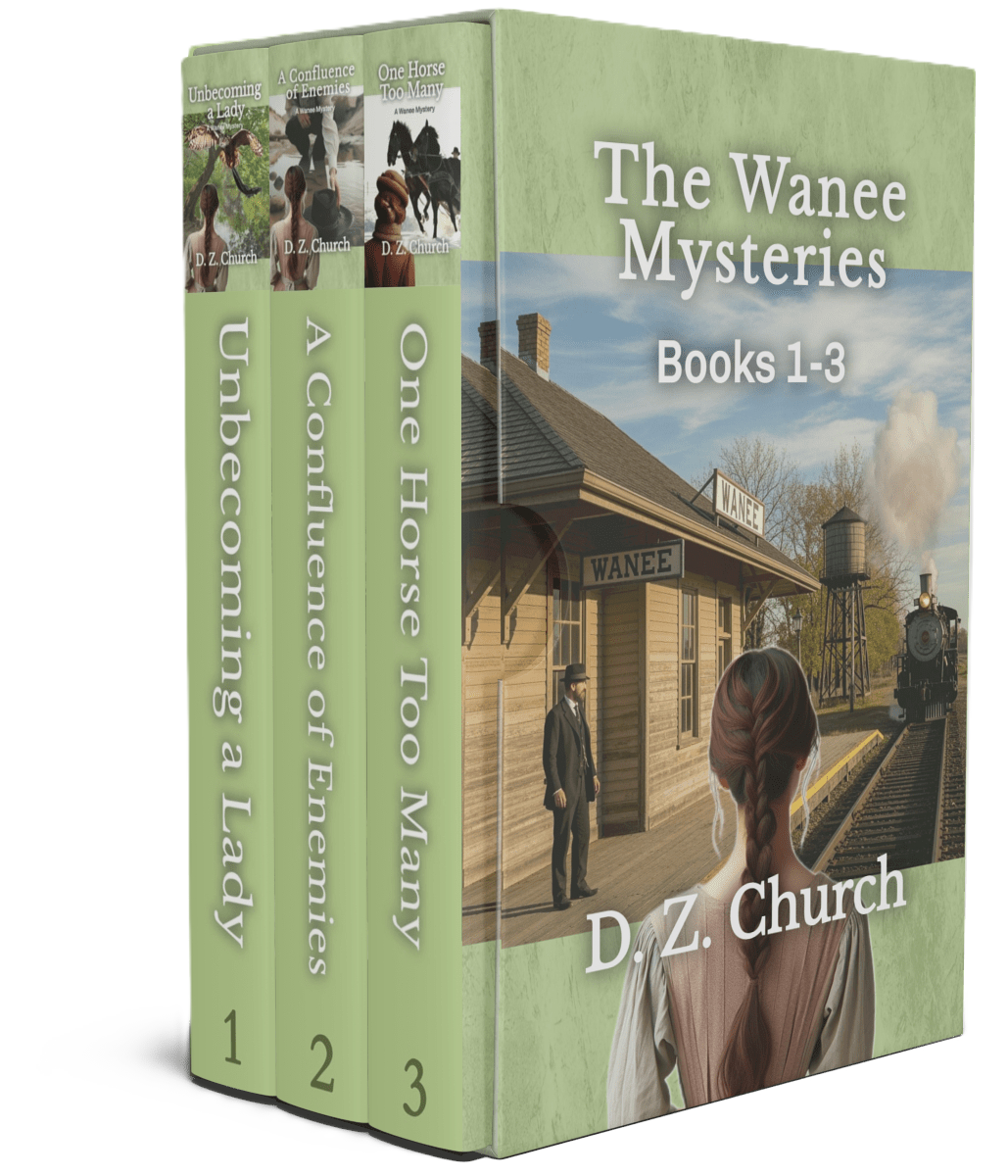
  1. Main Character. When I think of the detectives (amateur and otherwise) that I love, they all have one thing in common. The detectives are not observers, but are affected and changed by what they see. They grow, they learn, they change. The secret, I think, is to create characters that are true to their own code, their education, and their upbringing, then allow them to grow with each outing, even if that means abandoning their basic precepts while bringing the reader along, knowingly or un. For instance, in “One Horse Too Many”, Doc Shaw, raised by abolitionists, discovers he is prejudiced.
  2. Aging. One of my pet peeves as a reader is a series where no one ages. Come on! Am I to believe all that death and mystery happened in one place in one year? When I planned the Wanee Mysteries, I intended that the main protagonist, Cora Countryman, would begin as a girl unwilling to lose her short skirt and braid and grow into a fearless woman. I set my sights on each book occurring a minimum of three months after the book before, since one of my other goals was to have my stories unfold in a booming 1870s prairie town. To demonstrate its growth and incorporate the changes, both human and industrial, time could not be static, nor could people’s ages. So far, I’ve stuck to this goal, for why it is so important, read on.
  3. Daily life. One of my goals was to have those who populate Wanee, Illinois, provide a backdrop, depth and fun to the mysteries. That means the characters, subcharacters, and even the Methodist owl have lives that include romance, marriage, babies, death, and everything in between. As a consequence, Wanee is rich in Cora’s lifelong friends, one pregnant, one attempting to forge a new life, a young doctor challenged daily, a man attempting to redefine himself, and old friends living their lives. Two of the above are suitors, only one of whom can win. Or maybe, none. I pray their lives help define the period, the mores, small town life, and Cora. A reviewer notes: “I love Cora and all the surrounding characters. The voice is so solid, and the details are so vivid that I am transported back to the small, Midwest town circa 1876 every time.”
  4. The canvas. I set out to build a town grappling with growth and change as the backdrop for my stories. When the mysteries start, Wanee is a pretty sleepy place, or so everyone thinks. Yet the 1870s were anything but. The railroad opened up the country, and towns built water systems, bringing indoor bathrooms and electricity to the bigger cities. Small telephone companies sprang up, coal-fired boiler furnaces appeared, and people roamed, including hobos who stopped long enough to make money before moving on. Politics were raw as people continued to deal with the fallout of the Civil War. One reviewer notes: “Church populates the town with an array of fascinating characters and shows the upheaval of a changing society, as well as the lingering trauma of the Civil War.” So, I guess I can give myself a star for number 4.
  5. Point of View. I envisioned that Cora Countryman would always tell the tale from her point of view. Frankly, I struggle with maintaining this. The reason is that I created three other characters who could easily carry any story and are often at the heart of big doings, leaving Cora to discover details from them. The decision to begin “A Confluence of Enemies” from Sebastian Kanady’s point of view broke my rule right out of the gate. But it was needed to make the book work. So, I guess the rule is, it’s Cora’s way unless it isn’t. I think in the future there may be more isn’t. But, then, again, it won’t be her story. Darn!
  6. Bonus: To dangle or not to dangle. Let this bit of wisdom be a warning to us all. A reviewer writes: “This could have been the beginning of a great new series (in my humble opinion) if not for that bomb on the last page. Does it all go down the drain for a few more cents in future sales?” The truly unfortunate part of this is, if the reader had scanned the first pages of the next book, he would have discovered that his presumption was wrong. I guess it is my fault for ending with a joke between friends that was never intended as a dangle. I could always eliminate the offending bits, maybe I should? Accepting all thoughts on this, so feel free to comment.

Read about me, find my books, and sign up for my newsletter at https://dzchurch.com.

Summer flowers bring?

We have a gorgeous flow of Mule Ears (Wyethia) and Queen Anne’s Lace (Daucus carota) that swirls down the hillside behind our cabin, forming a river of color. While Mule Ears happily look like their sunflower cousins, Queen Anne’s Lace bears a striking resemblance to plants far less friendly. It brought to mind a 700-word mystery I wrote, featuring Cora Countryman (The Wanee Mysteries) and her brother Jess, on another summer day, 149 years ago on the Illinois prairie. I hope you enjoy it!

Queen Anne’s Lace

Photo by Vika Glitter on Pexels.com

Cora Countryman sat on a rock in a fast-running stream that bisected her brother Jess’s farm, watching a stand of delicately flowering Queen Anne’s Lace bobbing white in the breeze. Cows grazed nearby, a fat catfish swam in the shadows of the hazelnut bushes, and bugs glistened on a summer breeze that wafted the perfume of carrot, parsnips, and timothy grass warmed by the sun.

Across the stream, a white fence boxed in three graves. One was fresh; two were not. Cora waded across the knee-deep water, the hem of her plain calico smock held high, her feet bare, and leaned on a fence post. The new grave was marked by a plank, two question marks and a date scratched into the wood.

Jess had found a man and a woman right here, their bodies near tied in knots, their heads in the flowing stream, the girl clutching flowers in one hand. He buried them, no postmortem by the town’s doctor, no undertaker, nothing but a few words muttered over their open grave.

Not that Cora was a romantic, far from it. As soon as she was able, she intended to leave her hometown, her brother, her mother (wherever she was), and her suitors to see the world. She spun in her bare feet at the possibilities – London in the fog, Boston in the rain, Egypt in the sun, dark men with dark ways. She would be fearless but carry a derringer for insurance.

She spun again and tripped. Checking her feet, she discovered a fire ring, its rocks jumbled. The fire had been doused by water, leaving a sheen on the charcoal. In the same rush that knocked rocks aside, a tin cup had tumbled under a neighboring bush.

“Cora,” Jess called from upstream, wiping his hands clean on a thick stand of grass. “Louisa has supper on the table.”

Cora held up the tin cup. Jess joined her, fingering the cup as she had, then shrugged.

“How old were they?” Cora asked, eyeing the fire ring for more clues.

“Young. He was in trousers over a red union suit, which served as his shirt. He’d pushed up his sleeves in the heat. The girl was young, maybe sixteen, in a plain blue calico dress, short like yours. They looked to be out on a picnic by the hamper I found.”

“When you found them side-by-side, their heads underwater, weren’t you curious?”

Jess handed her the cup, wiping his hands on his trousers. “Just wanted to get them in the ground. The boy had welts on his arms, and they had thrashed about before they died. I didn’t want what they had. No mystery there.”

“They might have been murdered or committed a lover’s suicide to be together forever. What about their families?”

“They were diseased, Cora. The best thing to do was get them buried.” Jess began picking Queen Anne’s Lace, gathering the tall stems in his left hand, the delicate white heads of the flowers forming a lacy umbrella. “There was a name in the basket. When I gave it to the Constable, he said he’d track down their folks.

“What flowers was she holding?” Cora asked, toeing the ground around the fire ring. When a tuber emerged from the coals, she lifted it from the ground with her toes. One end was cut. She let it fall, wiggling her toes in the charcoal.

“These.” As he shook the lacy flower heads, several ladybugs took flight.

“Not those?” Cora pointed to a stand of white lacy-headed flowers downstream.

Jess grinned. “Do you find mystery everywhere?”

“You missed it, but I’m right, right?”

“The girl dug a tuber to make tea for their picnic.”

“Believing it was parsnip by the smell,” Jess said, holding the cup to Cora’s nose.

“Purple spots will kill you lots.”

“As our thieving mother used to say,” Jess said, turning for the farmhouse and supper.

Find me at: https://dzchurch.com, where you can sign up for my newsletter and discover more about my books. To follow Cora Countryman, find the series at: https://www.amazon.com/dp/B0CPW5H3LM